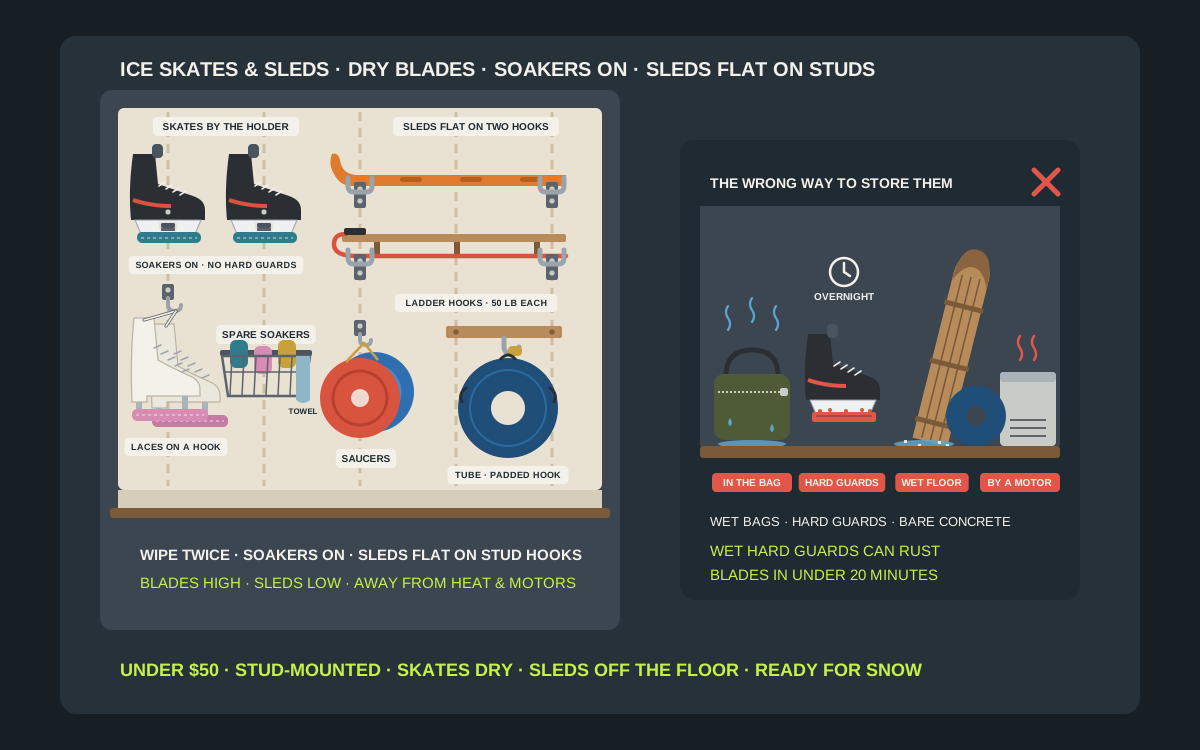
Ice skates and sleds are the winter gear that never has a home. Skates come back from the rink wet, get dropped on the garage floor still in their bag, and turn up a week later with orange freckles on the blades. Sleds are bulky, awkward and used maybe a dozen days a year, so they lean against the wall behind the car, slide over when someone brushes past, and spend the summer sitting in whatever leaks out from under the lawn mower. Both problems are cheap to fix. A pair of skate hangers, a screwed hook, two ladder hooks and a few minutes with a stud finder will get a family’s winter gear off the floor for well under $50. The parts that matter are the ones generic hooks ignore: skates need air and dry blades, long sleds need support at both ends, and some gear should not stay in a damp garage all year. This guide covers which hanger suits which skate or sled, how to dry skates before they go up, where the winter wall should go, and what to move indoors when the snow is gone.
Shop ice skate & sled wall hangers on Amazon
Who this is for
- Hockey and figure skating families who come home from the rink with several wet pairs and want them drying on the wall instead of in a zipped bag
- Parents with a garage full of sleds, saucers and snow tubes who want them off the floor, out of the car’s way and easy for kids to grab on a snow day
- Anyone setting up a winter wall this fall who wants skates and sleds to share one stud-mounted zone near the door
Quick answer
For most garages, the best under-$50 setup is two separate zones on one wall. For skates, use hangers that hold each skate upright by its blade holder, or a single screwed hook that holds a pair by the tied laces, and only after the blades are wiped dry and in soft soakers, never in hard guards. For sleds, lay toboggans and runner sleds flat across two hooks screwed into studs, such as a pair of Rubbermaid FastTrack Ladder Hooks rated at 50 lb each. Hang plastic sleds and saucers from one hook by their rope or molded handles. A senior hockey skate weighs roughly 1.8 lb and a 48-inch steel runner sled about 12 lb, so the hardware is not the hard part. Keeping skates dry, and moving them indoors if your garage is humid in summer, is. Check the hanger’s fit and the current price on the listing before you buy.
Quick comparison
| Hanger | Best for | How it holds the gear | Trade-off |
|---|---|---|---|
| Blade-holder skate hangers | Hockey and figure skates you use every week | Each skate sits upright on a cradle that holds the blade holder | Check the fit for your holder; plastic ones dislike heat |
| One screwed hook by the laces | One or two pairs on a tight budget | The pair hangs from tied laces with soakers on the blades | Blades can knock together; keep laces loose and dry |
| Open wire skate rack or basket | Several pairs plus soakers and gloves | Skates stand or lie in open wire that lets air through | Takes more wall; many wire racks cost more than $50 |
| Two ladder hooks | Toboggans and steel runner sleds | The sled lies flat across two stud-mounted hooks | Needs 4 to 6 feet of clear wall |
| Single hook through a rope or handle | Plastic sleds and saucers | The sled hangs from its pull rope or molded hand grip | Swings when bumped; not for heavy sleds |
| Padded hook or shelf for a snow tube | Inflated snow tubes in their covers | The tube hangs by its handles or rests on a shelf out of the sun | Bulky; keep it away from motors and heat |
Skate blade soakersGarage ladder hooks for sledsHeavy-duty garage utility hooks
What to look for
It holds skates by the holder or the laces, never by the edge
A sharpened skate blade is a precision edge, and a metal hook resting on it is a good way to put a nick in it. Look for hangers that cradle the plastic blade holder, the part between the boot and the steel, or hang the pair by its laces from a hook. Several small makers sell 3D-printed skate hangers that hold each skate upright by the blade holder, either screwed to the wall or clipped onto a pegboard, and some are made to fit rail systems such as Rubbermaid FastTrack. Load is not a concern: Pure Hockey lists a senior Bauer Supreme M4 at about 810 g per skate in size 8, so a pair is under 4 lb. Fit is the thing to check, because holder shapes differ between hockey, figure and recreational skates.
It lets the skates breathe
Every skate maker says the same thing in different words: skates need air. Riedell tells skaters to let boots dry at room temperature rather than going straight into a locker or bag, and Jackson tells owners to take skates out of the bag once they get home so the materials can dry and mold cannot grow. An open hanger, a hook or an open wire rack lets air reach the boot, the tongue and the blade. A closed cabinet, a lidded tub or the skate bag itself does the opposite.
It supports long sleds at both ends
Sleds come in very different shapes. Flexible Flyer lists its classic steel runner sled at 48 by 20.5 by 6.5 inches and 12 lb, its plastic Winter Lightning toboggan at 48 by 17 by 4 inches, and its ash toboggan at a full 72 inches long and 10 lb. Anything that long should rest flat across two supports screwed into studs, not hang from one hook in the middle where it can tip and swing. Rubbermaid’s FastTrack Ladder Hook is rated at 50 lb, can snap onto a FastTrack rail or mount straight to the wall, and is sold for horizontal storage with two hooks, which is exactly what a toboggan needs. Measure your longest sled and make sure the wall has room for it plus a few inches at each end.
Screws into studs, not adhesive strips
Garages are hard on adhesive. Command’s indoor strips are made for about 50°F to 105°F, and an unheated garage leaves that range behind for most of the winter, which is exactly when skates and sleds come and go every day. Find the studs, screw the hooks or a rail into them, and the sleds will stay up at any temperature. Save adhesive hooks for light, dry items in a heated mudroom.
It fits your garage climate
This is the question most storage guides skip. A garage can be a fine place for skates during the season, if it stays fairly dry, and a poor one all summer, if it gets hot and humid. Bladetech Hockey’s off-season guide says garages work if they don’t get excessively hot and humid, while ProStock Hockey suggests avoiding spaces without moisture control, such as a garage or a car trunk. Sleds, saucers and toboggans tolerate a garage much better. So choose skate hangers you can move, or plan a second spot indoors for skates in the off-season, and let the sleds stay on the garage wall all year.
Dry the skates before they go on the wall
Wipe the blades, then wipe them again
Drying starts at the rink, not in the garage. Riedell tells skaters to wipe the blades and the mounting surfaces dry when the skates come off, so the screws do not rust, and to wipe them again a couple of minutes later, because condensation forms as cold steel warms to room temperature. Jackson recommends a heavy cotton towel for the same job. Two wipes take a minute and do more for a pair of blades than anything else. Keep a small towel by the hangers for the second wipe at home.
Soakers on, hard guards off
Skaters use two kinds of blade covers, and they are not interchangeable. Hard guards are for walking from the bench to the ice. Soakers are soft, absorbent covers for everything else. Riedell says not to store blades in hard guards because they hold moisture against the steel, CRS Cross says the same, and Jackson warns that blades can rust in less than 20 minutes in wet guards. US Figure Skating’s magazine advises never leaving guards on overnight. Put dry soakers on after the wipe, so they soak up the last of the condensation while the blades warm.
Open the boots up
The boot needs to dry as much as the blade. Bauer’s post-game care list says to wipe the blade, remove the footbed and air dry it, and loosen the laces. Riedell adds pulling the tongue forward and wiping the boots inside and out, since moisture and bacteria from your feet can damage leather. Jackson says to keep boots away from heating vents, which dry the materials until they crack, and never to store boots in a car trunk, where extreme temperatures break them down early. Hang skates with the laces loose and the tongues open, away from the water heater and furnace.
Rotate and wash the soakers
Soakers work because they absorb water, which means they get damp. US Figure Skating’s magazine suggests checking them now and then and, if they feel damp, turning them inside out and tossing them in the dryer for about 10 minutes. Banff Hockey School suggests keeping a second pair so one can dry while the other is in use, and washing them regularly. A small wire basket or a hook next to the skate hangers is a good home for the spare pair, the hard guards and a skate towel, so everything for the next trip to the rink is in one place.
Three ways to hang ice skates
Blade-holder hangers, one per skate
These are the neatest option for a family that skates every week. Each hanger is a small bracket that cradles the plastic blade holder, so the skate sits upright with the boot open to the air and the steel facing down and away from hands. SuperheroDIY’s 3D-printed hanger, for example, holds skates by the blade holder and comes either with wall-dog style drywall screws or with fittings for IKEA Skadis pegboard, and the maker warns that its plastic softens above 150°F, so keep it off a sun-baked wall. LVMR Creations sells a version for Rubbermaid FastTrack rail, a French cleat or the bare wall, rated for 0°F to 120°F. If you already have a rail or pegboard wall, buy the version made for it, and give each skater a pair at their own height.
A screwed hook by the tied laces
The cheapest skate hanger is a hook you already own. Tie the laces of a pair together near the ends, put soakers on the blades, and hang the pair from a sturdy hook screwed into a stud, high enough that the blades are well above a small child’s head. It has trade-offs: the blades of the two skates can knock together when the pair swings, and the laces stay tight around the hook instead of loose in the eyelets, which is not ideal for drying. Use it for one or two pairs and keep soakers on.
An open wire rack or basket
Wire skate racks and baskets hold several pairs plus the soakers, guards and gloves that go with them, and open wire lets air move around everything. Organized Living’s Skate Rack with Basket, for example, holds two pairs of skates with a basket for accessories, mounts to its wire grid, to most slatwall or straight to the wall, and is made of epoxy-coated steel. It lists above our $50 budget, as dedicated wire skate racks often do. A plain open-wire basket screwed into the studs, with the skates set in toe-down and soakers on, does much of the same job for less.
Know your sleds before you buy hooks
Steel runner sleds
The classic wooden-deck sled with red steel runners is heavy and long: Flexible Flyer lists its 48-inch steel runner sled at 48 by 20.5 by 6.5 inches and 12 lb, with pre-drilled holes for a pull rope. Lay it flat across two hooks with the runners resting on them, the steering bar toward the door so it is easy to grab. Wipe the steel runners dry after the last ride of the season. NSCS recommends rubbing oil down metal runners before storage so they do not rust over the summer.
Plastic and wooden toboggans
A plastic toboggan such as Flexible Flyer’s Winter Lightning is 48 by 17 by 4 inches and made of light polyethylene, so it can hang from two hooks or even one hook through a molded hand grip. A wooden toboggan is a different animal: Flexible Flyer’s ash toboggan is 72 inches long, 14.25 inches wide and 10 inches tall, and weighs 10 lb. Northern Toboggan says it has stored its toboggans standing up with the curl against the wall, hanging horizontally on straps or wall mounts, and lying flat, and that the important thing is keeping the wood off the ground. Two ladder hooks, or two straps from screwed hooks, suit most garages.
Saucers and discs
Saucers are the easiest sleds to store. Flexible Flyer’s steel saucer is 26 inches across, about 4 inches tall and 6 lb, its plastic Flying Saucer is the same diameter, and its foam saucer weighs about 1 lb. All of them hang from a single hook by their rope handles or molded grips, and several plastic saucers nest together on one hook. Hang the heavier steel saucer on its own hook, and keep the plastic stack low enough for kids to lift one off without help.
Snow tubes
Inflatable snow tubes are the bulkiest winter gear in most garages. Tube Pro, which makes snow tubes, says it is ideal to leave the tube inflated inside its cover in a spot with little sunlight and air circulation, away from sources of ozone such as electric motors, and never in contact with petroleum-based materials. If you must deflate it, Tube Pro says to avoid sharp creases, not to vacuum it tight, and to store it in a black plastic bag tied shut. In a garage, that means a padded hook or shelf away from the freezer, the garage door opener’s motor and the gas cans.
Three ways to hang sleds
Two ladder hooks, sled lying flat
This is the default for toboggans and runner sleds. Screw two ladder hooks, or two long J-hooks, into studs at the same height, set a little closer together than the length of the sled, and lay the sled across them. Rubbermaid’s FastTrack Ladder Hook is rated at 50 lb and is made to be used in pairs for horizontal storage, so two of them hold any family sled with plenty of margin. Put the heaviest sled lowest and keep the hooks clear of the car door.
One hook through a rope, grip or hole
Light plastic sleds, saucers and discs hang well from a single hook. Storage guides from NSCS point out that most plastic sleds have hanging holes or an attached rope for exactly this purpose, and hanging keeps heavier things from being stacked on them and bending them. Use a screwed utility hook, not an adhesive one, and hang the sled so it lies flat against the wall rather than sticking out into the walkway. A row of hooks at kid height lets children help themselves.
Upright, strapped to the wall
If wall width is short, a sled or toboggan can stand on end. Stand it on a rubber mat or a scrap of board rather than bare concrete, with the curl or the front of the sled up, and hold it to the wall with a strap or bungee clipped between two screwed hooks so it cannot slide or tip. It takes less wall than a pair of ladder hooks and more care, because a falling toboggan is heavy enough to hurt.
Off-season care that keeps winter gear ready
Plastic sleds
Plastic sleds need very little: clean off grit, let them dry completely, and hang them. NSCS notes that moisture left on plastic can grow mildew, which stains, and that hanging keeps heavier items from deforming them. Keep plastic sleds away from a sunny window or a wall that bakes in the afternoon sun. Dog Paddle Designs, which builds dogsleds, notes that UV light weakens sled plastics over time and that it is worth storing a sled out of intense sun.
Wooden sleds and toboggans
Wood needs a little more attention. NSCS suggests checking that the finish is still sealed and touching up any cracks before storage. Northern Toboggan adds that wooden sleds like to breathe with the season rather than sit in a tightly climate-controlled room, and suggests an old sheet or tarp to keep dust and droppings off in a shed. Storage of America warns against setting sleds on a tarp or blanket, where moisture collects underneath, so if you cover a wooden sled, drape a breathable sheet over it on the wall rather than laying anything under it.
Skates in the summer
Skates are the gear most worth moving. Bladetech Hockey’s off-season guide says to dry the blades completely, apply a light blade oil or corrosion inhibitor if you live somewhere humid, store them with soakers rather than hard guards, and never seal them in a plastic bag or bin. Jackson also suggests a thin film of light oil on the blades now and then to prevent rust. If your garage gets hot and sticky in summer, take the skates off the hangers in spring and put them on a closet shelf indoors. The hangers stay up for next season.
A quick check before the first freeze
In late fall, walk the winter wall and check that every hook is still tight in its stud, the sleds have no cracks, the steel runners have no rust, the snow tube holds air, and the skate blades are sharp and rust-free. Bauer suggests sharpening skates after every two to three hours of ice time, so the start of the season is a natural moment for a fresh edge. Swap in fresh soakers and the whole wall is ready for the first snow day.
Where the winter wall should go
By the door you leave from
Skates and sleds that live by the door get used. Put the winter zone on the wall between the house door and the garage door, next to the boots and the snow shovel, so heading out is one stop instead of a search. Our guide to snow shovel and ice scraper wall holders covers the rest of that wall, and the winter tire and seasonal gear guide covers the heavier items further back.
Kid height for sleds, higher for blades
Sharp blades and small children do not mix. Hang skates high enough that the steel is above a child’s reach, with soakers on, and put the hooks for plastic sleds and saucers low enough for kids to lift them down themselves. Heavy runner sleds and toboggans go in the middle: low enough for an adult to lift down safely, high enough to clear the car.
Away from heat, motors and the car door
Keep the winter wall away from the water heater, furnace and dryer vent, which dry out skate boots, and away from the freezer and other electric motors if a snow tube lives there, for the ozone reasons Tube Pro gives. Leave clearance for the car door, so a sled does not end up with a dent, or the car with a scratch, every time someone gets out.
Into studs, or solid masonry anchors
Find the studs with a stud finder and screw every hook into them. Most garages have studs every 16 inches, so two studs 32 inches apart make a natural spacing for a pair of ladder hooks under a 48-inch sled. On concrete or block walls, use masonry anchors rated for the wall and the load. If the garage is block, our guide to mounting pegboard on a concrete garage wall walks through the anchors.
Mistakes to avoid
- Zipping wet skates into the bag and leaving them there until the next practice.
- Storing skates with hard guards on the blades instead of soft soakers.
- Resting a sharpened blade on a bare metal hook, where the edge can be nicked.
- Hanging a 48-inch or 72-inch sled from one hook in the middle, where it tips and swings.
- Leaning sleds on the bare concrete floor, where they sit in meltwater and road salt.
- Using indoor adhesive hooks in an unheated garage for sleds or skates.
- Keeping a snow tube next to the freezer motor or in a sunny window.
- Leaving skates on the garage wall all summer in a hot, humid garage.
Related guides
Browse the hub: Garage wall storage under $50 - all guides
- Best Snow Shovel & Ice Scraper Wall Holders Under $50
- Best Winter Tire & Seasonal Gear Wall Storage Under $50
- Best Ski and Snowboard Wall Racks for Garages Under $50
- Best Hockey Stick Wall Racks Under $50 for Garage Storage
- How to Do a Fall Garage Cleanout with Wall Racks Under $50
- Best Garage Track Rail Hooks Under $50
FAQ
What is the best way to store ice skates in a garage?
Wipe the blades dry twice, put soft soakers on, loosen the laces, pull the tongues forward and hang the skates upright on blade-holder hangers screwed to the wall, away from heat. If the garage gets hot and humid in summer, move them indoors for the off-season.
Can I hang ice skates by the laces?
Yes, for one or two pairs. Tie the laces together, put soakers on the blades and hang the pair from a sturdy hook screwed into a stud, well above a child’s reach. Blade-holder hangers are better for drying because the laces stay loose and the blades cannot knock together.
Should I store skates with blade guards on?
Not hard guards. Riedell and CRS Cross both say not to store blades in hard guards, which are meant for walking and hold moisture against the steel, and Jackson warns that blades can rust in less than 20 minutes in wet guards. Wipe the blades dry and use soft, absorbent soakers instead.
How do I hang a sled on a garage wall?
Lay toboggans and runner sleds flat across two ladder hooks or long J-hooks screwed into studs, such as Rubbermaid FastTrack Ladder Hooks rated at 50 lb each. Hang plastic sleds and saucers from a single screwed hook by their rope or molded handles.
Is it OK to keep ice skates in the garage all year?
Only if the garage stays fairly cool and dry. Bladetech Hockey says garages work if they don’t get excessively hot and humid, while ProStock Hockey suggests avoiding spaces without moisture control. If yours gets muggy in summer, store skates indoors from spring until fall.
How should I store a snow tube?
Tube Pro says it is ideal to leave the tube inflated in its cover where sunlight and air circulation are low, away from electric motors and petroleum products. If you deflate it, avoid sharp creases and store it in a black plastic bag tied shut.
Bottom line
The best ice skate and sled wall hangers are simple: blade-holder hangers or a screwed lace hook for skates, two ladder hooks for toboggans and runner sleds, and single hooks for saucers, plastic sleds and a snow tube, all screwed into studs by the door. Dry the skates twice, swap hard guards for soakers, keep blades high and sleds low, move skates indoors if summer gets humid, and check the hanger’s fit and the current price on the listing before you buy.