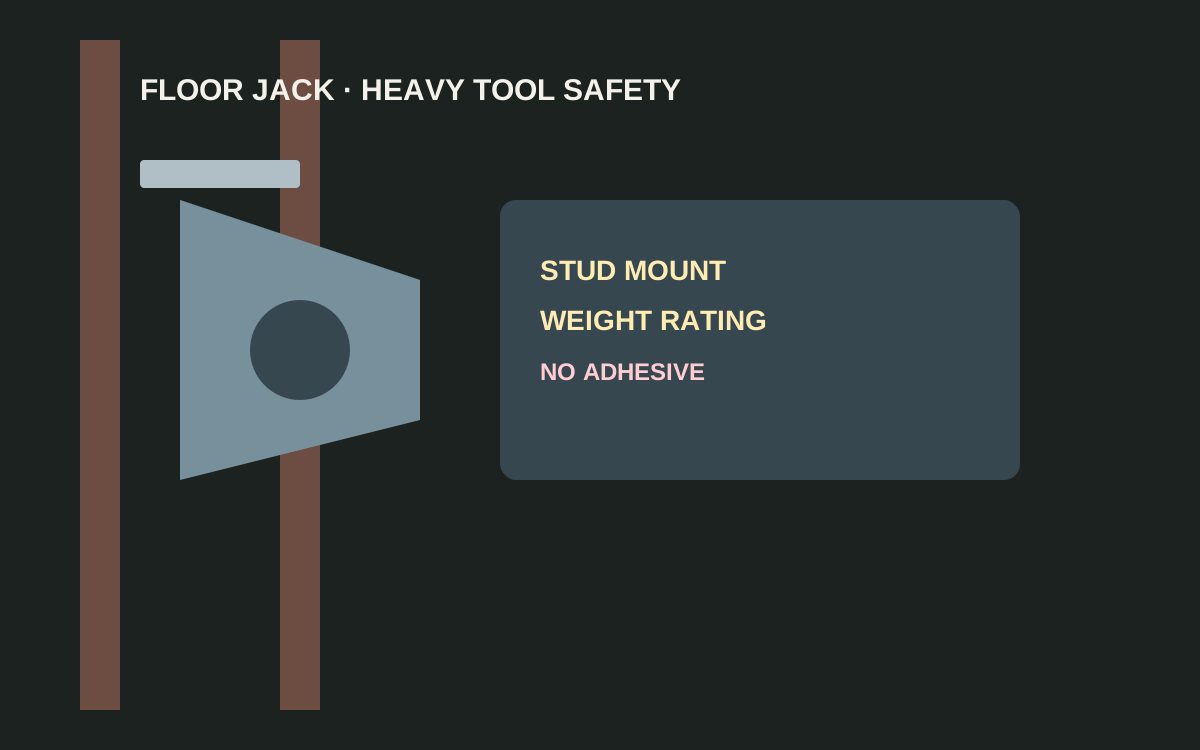
Floor jacks are heavy tools. Under $50, the only honest wall-hanger plan is hardware rated for the jack’s real weight, screwed into wall studs (or a structural backer spanning studs) — never adhesive hooks, never hollow drywall alone, and never a guess at capacity. Read the hanger’s stated weight rating, weigh or check your jack’s spec, add a safety margin, keep the hang clear of walkways, and use secondary straps if the design calls for them. This guide does not claim every under-$50 hook is safe for every jack.
Shop floor jack wall hangers on Amazon
Who this is for
- Home mechanics clearing floor space under aluminum or steel floor jacks
- Garage owners comparing wall hangers with floor trays for heavy jacks
- Anyone who refuses adhesive “heavy duty” claims for lifting equipment storage
Quick answer
Floor jacks are heavy tools. Under $50, the only honest wall-hanger plan is hardware rated for the jack’s real weight, screwed into wall studs (or a structural backer spanning studs) — never adhesive hooks, never hollow drywall alone, and never a guess at capacity. Read the hanger’s stated weight rating, weigh or check your jack’s spec, add a safety margin, keep the hang clear of walkways, and use secondary straps if the design calls for them. This guide does not claim every under-$50 hook is safe for every jack.
Quick comparison
| Format | Best for | Typical price band | Why it wins |
|---|---|---|---|
| Stud-mounted heavy hook / cradle | Rated floor jacks within hanger limit | Usually $20–$50 | Only with verified weight rating + studs |
| Plywood backer across multiple studs | Spreading load on imperfect walls | Usually $15–$40 materials | Safer than single hollow-wall anchors |
| Floor tray / dolly (non-wall) | When ratings or studs are wrong | Usually under $50 | Honest fallback |
| Adhesive or hollow-wall only | Never for floor jacks | — | Unsafe for this tool class |
What to look for
Weight rating first
Match the hanger’s stated working load to your jack’s actual weight with margin. Never infer a rating from a photo or a vague “heavy duty” label.
Stud mounting is mandatory
Lag into studs or a structural backer fastened to studs. Drywall anchors and adhesive are not a floor-jack plan.
Secondary restraint
Prefer designs with a lip, pin, or strap so the jack cannot bounce off on a slam or bump.
Clearance and drop path
Mount where a failure would not crush feet, pets, or a vehicle path. Keep the area below clear.
Safety rules before you buy
Confirm jack weight and hanger rating
Use the manufacturer’s jack weight or a scale. The hanger’s published working load must exceed that with margin — if the listing is vague, skip it.
Plan stud layout
Use a stud finder, verify with a small probe where allowed, and mark centers. One stud into a heavy steel jack is often not enough — many mounts want two.
Reject adhesive and hollow-wall-only kits
Marketing language does not rewrite physics.
Keep kids and pets in mind
A hanging jack is still a dense falling hazard if mounting fails.
Where floor jack hangers earn their place
Along a stud wall beside the parking bay
Frees floor space without blocking the car door.
On a backer board spanning studs
When you need more screw meat than a single stud face.
Not above a primary walkway without a belt-and-suspenders restraint
Drop path matters.
How to install for the real load
Dry-fit the jack on the hanger before final lagging
Confirm saddle shape and balance.
Use structural fasteners sized for the load
Follow the hanger maker’s hardware guidance; do not substitute random drywall screws.
Add the secondary strap or pin if included
Then proof with a careful lift-and-settle — never bounce-test over your feet.
Treat price bands as moving targets
Kits change with sales. Check the current weight ratings, dimensions, and price on the listing before you buy.
Mistakes to avoid
- Trusting adhesive hooks or hollow-wall anchors with a floor jack.
- Ignoring the hanger’s weight rating or inferring one from “heavy duty” wording.
- Lagging into a single uncertain drywall hit without finding studs.
- Mounting over a walkway with no secondary restraint.
- Assuming a low-profile aluminum jack is “light enough” to skip ratings.
Related pick: Best Car Ramp Wall Hooks & Hangers Under $50 for the Garage
Related guides
Browse the hub: garage wall storage under $50 - all guides
- Best Torque Wrench Wall Holders Under $50 for Garage
- Best Grease Gun Holders Under $50 Wall Mount
- Best Fire Extinguisher Wall Mounts Under $50 for Garage
FAQ
What is the best floor jack wall hanger under $50?
Only a hanger with a clear weight rating above your jack’s weight, mounted into studs or a stud-spanning backer — otherwise keep the jack on the floor.
Can I use adhesive or Command-style hooks?
No. Floor jacks are heavy tools; adhesive and hollow-wall-only mounts are the wrong class of hardware.
How important is the weight rating?
It is the primary filter. If the listing will not state a working load, do not guess — choose another product or a floor tray.
What if my walls are only metal studs or block?
Use hardware rated for that substrate and the load, or keep the jack on a floor tray. Don’t force a wood-stud solution onto the wrong wall type.
Bottom line
Floor jack hangers under $50 are a stud-and-rating problem first: verify working load, mount into studs or a structural backer, add secondary restraint, and keep the drop path clear. If you cannot confirm ratings, park the jack on the floor. Confirm weights and capacities on the product page before you buy.