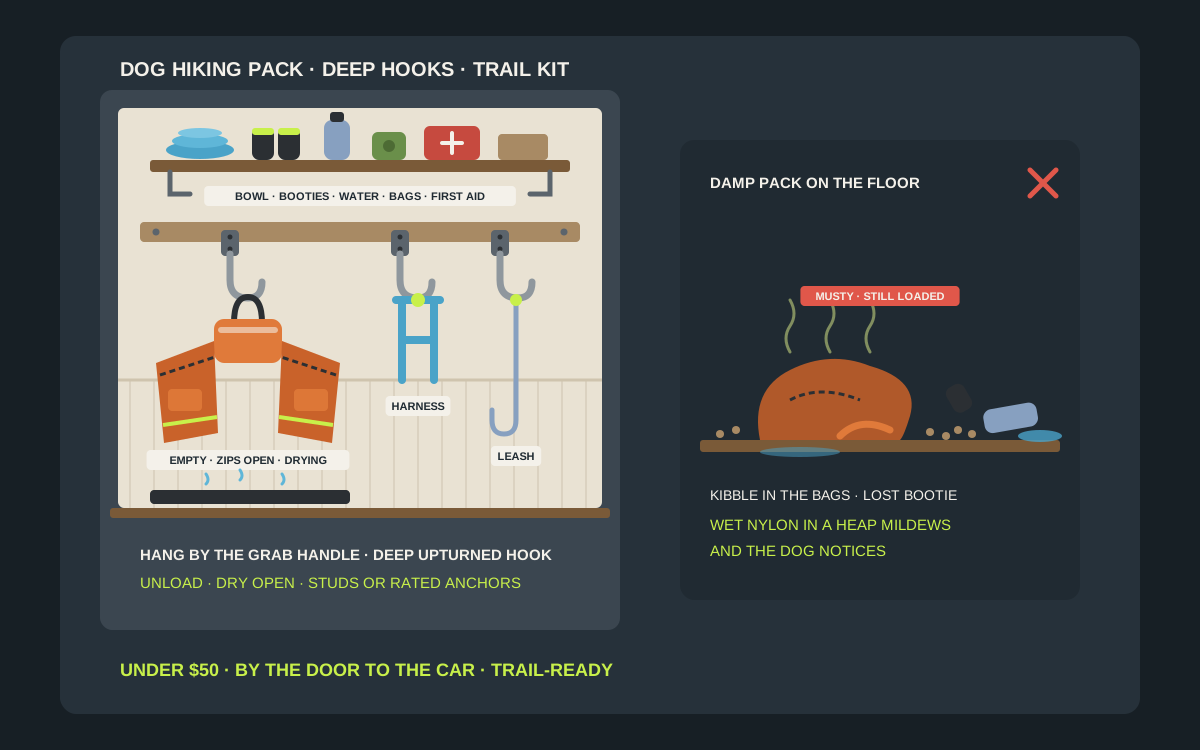
For most homes, the best under-$50 way to store a dog hiking pack is one deep utility hook with an upturned tip, mounted into a stud or a properly rated anchor by the door you leave from, with the pack emptied and hung open by its top grab handle so both saddlebags can air out. Give the trail harness and leash the next hook, and add a small shelf or wire basket above for the collapsible bowl, booties, waste bags and a light so the whole kit leaves together. An empty dog pack is light, but a pack still holding water bottles, a first-aid pouch and leftover kibble is not — and wet nylon left in a heap mildews fast. Unload, dry, then hang, and check the hook depth, wall-type guidance and price on the listing before you buy.
Shop deep utility hooks and rails for dog packs on Amazon
Who this is for
- Dog owners whose saddlebag hiking pack ends up in the car trunk, on the closet floor or under a pile of jackets, still damp from the last trail
- Households that hike or backpack with one or more dogs and want the pack, trail harness, collapsible bowl and booties in one grab-and-go spot by the door
- Renters and homeowners choosing between deep utility hooks, a mudroom rail, pegboard, an over-door rack or a shelf-plus-hook station for under $50
Quick answer
For most homes, the best under-$50 way to store a dog hiking pack is one deep utility hook with an upturned tip, mounted into a stud or a properly rated anchor by the door you leave from, with the pack emptied and hung open by its top grab handle so both saddlebags can air out. Give the trail harness and leash the next hook, and add a small shelf or wire basket above for the collapsible bowl, booties, waste bags and a light so the whole kit leaves together. An empty dog pack is light, but a pack still holding water bottles, a first-aid pouch and leftover kibble is not — and wet nylon left in a heap mildews fast. Unload, dry, then hang, and check the hook depth, wall-type guidance and price on the listing before you buy.
Quick comparison
| Format | Best for | Mounting | Trade-off |
|---|---|---|---|
| Deep utility hook (1–2) | One dog, one saddlebag pack hung by its grab handle | Screws into a stud or rated anchor; quality adhesive only for an empty pack on smooth paint | Simple and cheap; one hook holds only one item, so add a second for the harness |
| Mudroom hook rail (4–6 hooks) | Pack, trail harness, leash, rain shell and a towel side by side | Screws into studs across the rail | Whole trail kit in one glance; needs a stud run and more wall width |
| Pegboard panel + hooks + bins | Multi-dog households, several pack sizes, small trail items | Panel screwed to studs with spacers | Most flexible layout; bins hold booties and bowls; takes more wall |
| Over-door hook rack | Renters who cannot drill, light empty packs only | Hooks over a closet or mudroom door | Zero holes; door must still close and packs cannot dry well in a shut closet |
| Small shelf with hooks underneath | Pack and harness below, bowl, booties, bags and bottle above | Screws into studs (shelf brackets and hooks share the load) | Trail-day station in one spot; check the shelf and hook ratings separately |
Deep utility wall hooksMudroom hook railsPegboard hook kits with bins
What to look for
Hook depth and tip shape for a grab handle
Most saddlebag-style dog packs have a padded or webbing grab handle on top of the harness body, and that handle is what you hang from. A shallow coat peg lets the handle slide off the moment the pack swings; a deep utility hook or a J-hook with an upturned tip holds it securely. Pick a hook whose throat is wider than the handle is thick, with a rounded or coated finish so webbing does not fray. If your pack has no handle, a closed strap loop or the back D-ring area works, but avoid hanging it by a single buckle or an adjustment strap that can slip and deform.
Hang it open so both saddlebags dry
A dog pack comes home with damp padding from the dog’s back, creek splash in the bags and sometimes snow in the zips. Hung flat against the wall with the bags closed, it stays damp inside for days. Hang it from the handle so the saddlebags drop on either side with their zips open, leave a hand’s width of clear wall around it, and keep it out of a sealed cupboard. Air flow, not a fancy rack, is what stops the musty smell — and stops a dog from refusing a pack that stinks of last month’s trail.
Weight honesty: empty pack vs loaded pack
An empty dog pack weighs little. A pack still holding two water bottles, a bag of kibble, a first-aid pouch and a spare leash can weigh several times as much, and that is the load people actually hang after a tired hike. Plan the mount for the load you will really put on it. A single empty pack on a quality adhesive hook rated for your wall can work on smooth cured paint; anything that will ever hold a loaded pack, a second dog’s pack or a rail full of trail gear belongs on screws into studs or properly rated anchors.
Height, reach and the dog in the room
Mount the hook so the bottom of the hanging pack clears the floor and the baseboard heater, at a height you can reach one-handed while holding a leash in the other. Dogs who love hiking will happily pull a dangling strap off the wall as a hint, so keep loose straps tucked or buckled and keep the pack above nose-and-paw reach for a big dog standing on hind legs. Put it at the exit you actually use for trail days — usually the mudroom, garage entry or the door nearest the car.
Hook vs rail vs pegboard vs over-door vs shelf
When one or two deep utility hooks win
If you have one dog and one pack, two deep utility hooks are the best under-$50 answer: pack on the first by its grab handle, trail harness and leash on the second. Look for a hook with a long throat and an upturned or ball tip, a vinyl or rubber coating that is kind to webbing, and screw holes so you can mount it into a stud. This is also the cheapest way to try a spot before committing to a full rail — if the pack drips onto the floor or blocks a light switch, you move two screws, not six.
When a mudroom hook rail earns the wall
A rail with four to six hooks turns a scattered trail kit into a station: pack, trail harness, a long line or leash, a dog rain shell or cooling vest and a drying towel. Rails spread the load across several fasteners into the studs behind, which matters once a damp pack and a wet towel share the rail. Leave one hook empty as a parking spot for whatever comes home soaked, and space hooks wide enough that a hanging pack does not press against the next item and trap moisture.
When pegboard is worth the panel
Two or three dogs with different pack sizes fill a single rail fast. A pegboard panel lets you hang each pack on its own deep peg hook, clip a bin beneath for booties, a collapsible bowl, waste bags and a clip-on light, and label each row with the dog’s name and harness size. Mount the panel on studs with spacers so the hooks seat properly, and choose long-shank peg hooks rather than short ones meant for hand tools — a dog pack handle needs depth.
When an over-door rack is the renter move
An over-door hook rack holds an empty dog pack and harness with no holes at all. It is the right call when the lease bans drilling and the walls are textured. The catch is drying: a pack hung inside a closed closet stays damp. Hang the pack on the outside face of the door if the rack allows it, or let the pack dry fully on a chair or drying rack before it goes on the door. Confirm the door still latches over the bracket, and keep loaded packs off a door that swings — a heavy pack slamming into the frame wears both.
When a shelf with hooks underneath becomes the trail station
A small wall shelf with hooks underneath is ideal if trail days follow a routine: pack and harness hang below, and the shelf above holds a collapsible bowl, a water bottle, booties, a small dog first-aid pouch and a roll of waste bags. Everything that goes on the hike lives in one spot, and nothing small gets lost inside a saddlebag between trips. Mount the brackets and the hooks into studs; the shelf rating and the hook rating are separate numbers, so check both on the listing.
Unload, dry, then hang: the routine that saves the pack
Empty both saddlebags the moment you get home
Kibble crumbs, half-eaten chews and a forgotten waste bag inside a closed saddlebag are how a dog pack ends up in the bin. Tip both bags out at the door, put food back in a sealed tub, refill the waste-bag roll and return water bottles to the kitchen. An empty pack also means the hook carries a light, predictable load.
Dry the pack open, padding out
Hang the emptied pack by its handle with all zips open so the bags hang apart and the padded back panel faces the room. After a creek day or rain, give it a full day before you close it up. Never put a soaking pack in a sealed closet, a car trunk or a plastic bin, and keep it away from direct heater blast, which can stiffen some coated fabrics and buckles.
Rinse salt, mud and burrs before they set
Beach salt, dried mud and grass seeds work into webbing and zips. Brush the pack off outside, rinse or spot-clean according to the maker’s care label, and pick burrs out of the straps before hanging so they do not end up in your dog’s coat on the next trip.
Check buckles and straps before it goes back on the hook
A tired post-hike inspection takes thirty seconds: buckles click, side-release clips are intact, the chest strap still adjusts and nothing is chewed. Hang the pack with straps loosely buckled so they do not dangle within the dog’s reach or tangle with the harness on the next hook.
Build a grab-and-go trail kit by the door
Keep the pack and the trail harness separate
Many dogs wear a pack over a separate walking harness, or swap between the pack’s built-in harness and a daily one. Give each its own hook so you can grab the right one for a short walk or a full trail day. If your dog uses the same daily harness and leash for neighborhood walks, keep that on its own hook closer to the main door and let the hiking kit live a little further along the rail.
Store the small trail items in one container
A wire basket or a lidded bin on the shelf above the hooks should hold the bits that otherwise wander: collapsible bowl, booties, a paw balm tin, a spare leash clip, a clip-on light or reflective collar, waste bags and a small first-aid pouch. Pack it once, restock after each hike, and the pre-trail scramble disappears.
Label sizes for multi-dog homes
If two dogs share the wall, put a small label above each hook with the dog’s name and the pack size. Dog packs are sized by girth and chest, and a medium pack on a large dog chafes on the first long climb.
Keep it near the car, not the bedroom
Trail days start at the car. A hook by the garage entry, mudroom or back door means the pack, harness and water go out together. A pack stored in an upstairs closet is the one that gets left behind.
Installation that holds up to trail gear
Find studs or use the right anchor
Use a stud finder for rails, shelves and pegboard. Drive screws into studs where you can; where there is no stud, use anchors rated by the maker for the load and your wall type, and follow the listing’s guidance for drywall, plaster or masonry. A single empty pack is light, but a rail that will hold a damp pack, a wet towel, a harness and a leash at once deserves real fasteners.
Use adhesive only for light, empty loads
Quality adhesive utility hooks can hold an empty dog pack on smooth, cured paint after the maker’s full cure time. Clean the spot with isopropyl rubbing alcohol first, press firmly, and respect the stated weight rating with a margin. Do not use adhesive on textured walls, fresh paint or anywhere a loaded pack will be dropped onto the hook in a hurry — that sudden tug is exactly what peels a strip.
Dry-fit with the real pack
Hold the empty pack against the wall at the planned height before marking holes. Check that the saddlebags clear the light switch, the door swing and the shoe rack below, and that a second hook beside it will not make the harness press into the wet pack.
Protect the floor and wall from drips
Put a boot tray or a washable mat below the hook for wet days, and leave the wall surface uncovered behind the pack rather than wedging it against wallpaper or a painted wall that can stain. A pack that drips onto a boot tray is a pack you can hang the moment you walk in.
Move-out or rehang without scars
Remove the gear first. Release adhesive hooks with the maker’s slow pull-down method, and fill screw holes with spackle before painting. Never lever a loaded hook off drywall.
Mistakes to avoid
- Hanging the pack with water bottles, kibble and a first-aid pouch still inside, so the hook carries several times the load you planned for.
- Closing a damp pack up in a sealed closet, car trunk or plastic bin where the padding mildews.
- Using a shallow coat peg that lets the grab handle slide off the first time the pack swings.
- Hanging the pack by a single buckle or adjustment strap that slips and stretches out of shape.
- Trusting a small adhesive hook with a rail that will hold a wet pack, a towel and a harness at once.
- Leaving loose straps dangling where an excited dog can pull the whole pack off the wall.
- Storing the hiking kit in a back bedroom closet instead of by the door that leads to the car.
- Mixing booties, bowls and waste bags loose in a saddlebag where they vanish between trips.
Related guides
Browse the hub: Pet gear wall mounts under $50 - all guides
- Best Dog Harness & Leash Combo Wall Stations Under $50
- Best Dog Life Jacket Wall Hooks Under $50
- Best Dog Boot & Towel Wall Stations Under $50
- Best Dog Leash Wall Hooks Under $50
- Best Pet Travel Backpack Wall Hooks Under $50
- Best Camping Backpack Wall Hooks Under $50 for Cabins
FAQ
What is the best way to store a dog hiking pack on the wall?
Empty both saddlebags, open the zips and hang the pack by its top grab handle on a deep utility hook with an upturned tip, mounted into a stud or a rated anchor by the door you leave from. Put the trail harness and leash on the next hook and keep small trail items in a basket or bin above.
Should I hang a dog backpack loaded or empty?
Empty. A loaded pack weighs several times more, strains the hook and the pack’s own handle, and traps moisture and food smells inside the saddlebags. Unload at the door, restock the small items in a separate bin, and hang the pack light.
Can adhesive hooks hold a dog hiking pack?
A quality adhesive utility hook can hold an empty dog pack on smooth, cured paint after the full cure time, within its stated rating. For anything that will hold a loaded pack, more than one pack or a rail of trail gear, use screws into studs or properly rated anchors.
How do I dry a dog hiking pack before storing it?
Brush off mud and burrs outside, empty the bags, open every zip and hang the pack by its handle with the padded back panel facing the room. Give it a full day after rain or creek crossings, keep it out of closed closets and away from direct heater blast, and follow the maker’s care label for washing.
How is this different from pet travel backpack hooks?
Pet travel backpacks are carriers you wear with a cat or small dog inside, usually stored on a hook as a rigid or semi-rigid bag. A dog hiking pack is the saddlebag harness your dog wears on the trail; it needs a deeper hook for its grab handle, open-zip drying and a spot near the car with the trail harness and water.
Where should I mount a dog hiking pack hook?
At the exit you use for trail days — the mudroom, garage entry or back door nearest the car — high enough that the saddlebags clear the floor and a jumping dog, and low enough to reach one-handed while holding a leash. Keep it clear of light switches and door swing, with a boot tray underneath for wet days.
Bottom line
Dog hiking pack wall hooks under $50 work when the pack goes up empty, open and dry: one deep utility hook with an upturned tip for the grab handle, the trail harness and leash on the next hook, and a small shelf or bin for the bowl, booties and bags, all at the door that leads to the car. Use adhesive only for a single empty pack on smooth cured paint; put rails, pegboard and shelf stations on screws into studs or properly rated anchors, and check the current hook depth, ratings and price on the listing before you buy.