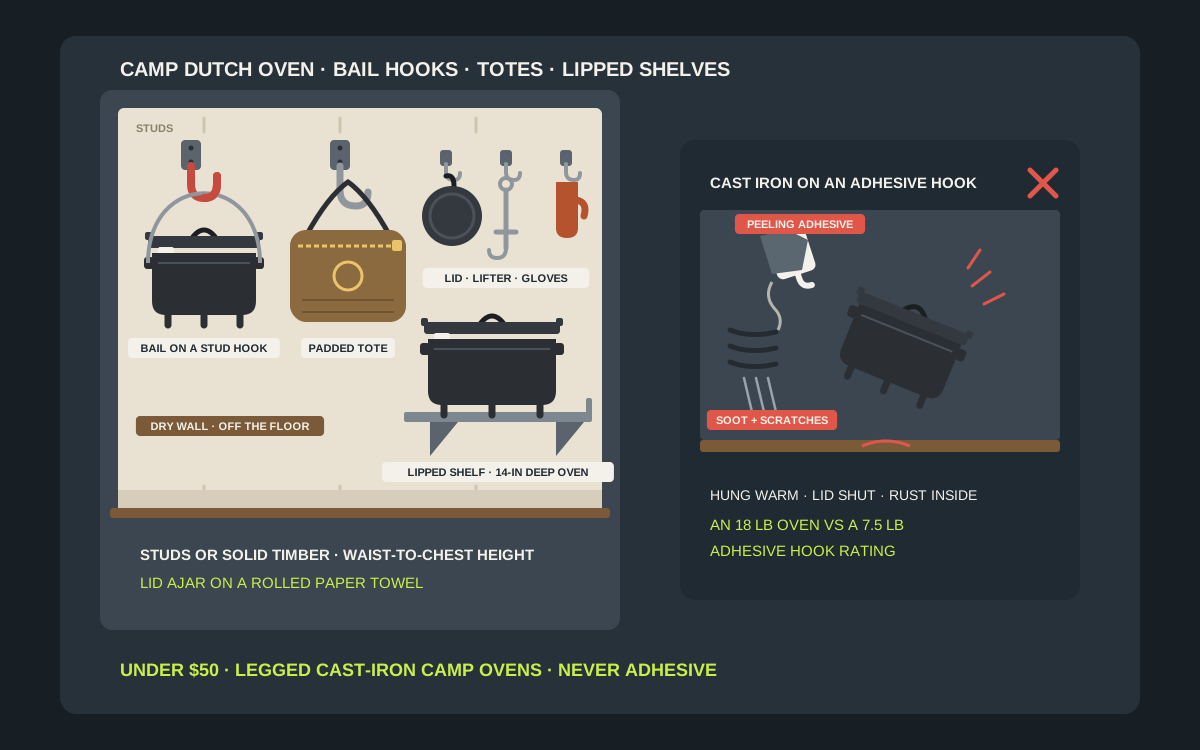
A camp Dutch oven is usually the heaviest single item in a camping kit, and it is shaped for a fire ring rather than a closet. Three cast-iron legs, a wire bail, a flanged lid built to carry hot coals and a body that weighs as much as a bag of dog food make it awkward on a shelf, risky on a peg and hopeless on anything held up by glue. Lodge’s own catalog lists its 10-inch, 4-quart camp oven at about 11.7 lb and its 14-inch deep oven at about 25.5 lb, before you add a lid lifter, gloves and a charcoal chimney. Under $50 of the right hardware puts all of it on one wall where it stays dry, ventilated and ready for the next trip, as long as the hook, the fasteners and the stud behind them are chosen for cast iron rather than for camp cookware in general.
Shop heavy-duty wall hooks for cast-iron Dutch ovens on Amazon
Who this is for
- Campers with one or two legged cast-iron camp Dutch ovens, the kind with a wire bail and a flanged lid for coals, that live on a garage floor, at the bottom of a closet or in the back of a truck between trips
- Scout leaders, cabin owners and outdoor cooks with a stacked set of 10-, 12- and 14-inch ovens plus lid lifters, lid stands, gloves and a charcoal chimney that deserve one organized wall
- Anyone deciding between a single heavy-duty hook, a padded tote on a hook, a pot rail, a bracket shelf or a separate lid-and-lifter station for under $50
Quick answer
For one camp Dutch oven, the best under-$50 setup is a vinyl-coated heavy-duty utility hook screwed into a stud, with the oven hung by its wire bail at waist-to-chest height and the lid propped open a crack on a rolled paper towel so air can move inside. If you own two or more ovens, or a 14-inch deep oven, a steel bracket shelf with a front lip screwed into two studs carries the weight more safely than any single hook, and the ovens stand on their own legs. Put the lid lifter, heat gloves and charcoal chimney on small hooks beside the main mount. Never use adhesive hooks for cast iron, never hang an oven that is still warm, and check the hook or shelf’s published load rating and current price on the listing before you buy.
Quick comparison
| Format | Best for | Mounting | Trade-off |
|---|---|---|---|
| Heavy-duty coated hook, hung by the bail | One 10- or 12-inch camp oven | One deep J or utility hook screwed into a stud at waist-to-chest height | Cheapest and fastest; one oven per hook, and the lid comes off first when you lift it down |
| Padded Dutch oven tote on a deep hook | Ovens that travel often, or pale walls you want kept free of soot | Both bag handles over one deep hook screwed into a stud | Contains soot and keeps the lid with the pot; check the handle stitching against the oven weight |
| Wall-mounted pot rail with S-hooks | Two lighter ovens plus a lid lifter, gloves and a chimney | Rail screwed into at least two studs, with heavy-gauge S-hooks | Tidy cook station; the rail rating and S-hook gauge set the limit, not the number of hooks |
| Steel bracket shelf with a front lip | 14-inch deep ovens, stacked sets and anything over about 20 lb | Two heavy-duty brackets into studs under a board or steel shelf with a lip | Strongest under-$50 option; needs more wall depth, and ovens are lifted onto it rather than hung |
| Lid-and-lifter station | Spare lids, lid lifter, lid stand, heat gloves and charcoal chimney | A short row of small hooks or a pegboard strip beside the main mount | Keeps every accessory with the oven; never meant to carry the oven body itself |
Padded Dutch oven tote bagsWall-mounted pot rails with S-hooksHeavy-duty steel shelf brackets
What to look for
Know what your oven actually weighs
Camp Dutch ovens are sold by diameter and quarts, but on a wall the number that matters is weight. Lodge’s published catalog puts its 10-inch, 4-quart camp oven at about 11.7 lb, the 10-inch deep 5-quart at about 13.1 lb, the 12-inch 6-quart at about 18 lb, the 12-inch deep 8-quart at about 19.4 lb and the 14-inch deep 10-quart at about 25.5 lb. Other cast-iron brands land in a similar range for similar sizes. If your oven came without paperwork, weigh yourself holding it on a bathroom scale and subtract your own weight. Whatever hook, rail or shelf you choose should carry that number with a generous margin, because cast iron gets set down hard rather than placed gently.
Hook throat that cradles the bail
A camp oven hangs by its wire bail, so the hook has to hold a round steel wire without letting it creep toward the tip. Look for a deep J or utility hook with an upturned end and a throat wide enough that the bail drops fully into the curve instead of perching on the lip. Vinyl or rubber coating stops the steel bail from grinding through the hook’s finish and keeps the oven from rattling when a door slams. Shallow cup hooks, slim robe hooks and single-screw coat hooks are the wrong shape, and almost always the wrong strength.
Studs, timber or masonry behind every fastener
An 18 lb oven that is lifted off and swung back on after every trip is a working load, and repeated jolts are exactly what loosen hollow-wall anchors over a season. Drive screws into studs, into the solid log or plank wall of a cabin, or into a wood strip screwed across two or more studs. On a concrete-block or poured garage wall, use masonry screws or anchors sized for the block and the load. Adhesive is simply out: Command’s Jumbo Utility Hook, one of the largest in its range, is rated for 7.5 lb, well short of even the smallest common camp oven.
Room for legs, lid and air
The three legs and the flanged lid make a camp oven deeper and taller than a kitchen pot of the same capacity. Leave enough projection that the legs never press into the wall, and enough clearance above the hook that you can lift the oven off without the bail or lid catching a shelf. Lodge recommends storing its camp ovens with the lid ajar so moisture cannot collect inside, and suggests a rolled-up paper towel to hold the gap, so plan a space where the lid can sit cracked open while the oven hangs or stands.
A dry wall that can live with a little soot
Cast iron hates damp air. A garage wall that sweats in spring, or a utility room next to a washing machine or water heater, will spot a well-seasoned oven with rust faster than any campfire. Choose an interior wall or the driest corner of the garage, away from vents and anywhere water pools on the floor. Even a clean, oiled oven leaves faint carbon marks on pale paint over time, so a coated hook, a fabric tote or a painted plywood panel behind the mount keeps the wall presentable.
Hook vs tote vs rail vs shelf vs lid station
When one heavy-duty hook is all you need
Most households own one camp oven, usually a 10- or 12-inch model, and for that a single vinyl-coated utility hook is the simplest answer. Screw it into a stud, hang the oven by its bail so the body sits a few inches clear of the wall, and set the lid on top with a rolled paper towel holding it open a crack. The bail is built to carry a full oven of food over a tripod, so an empty, clean oven is well within its everyday job. Before you hang it, check the bail ends where they hook into the cast ears; a bent or worn bail belongs on a shelf until it is replaced.
When a padded tote earns its place
A padded Dutch oven tote turns the oven, lid and lifter into one carry item and keeps soot, charcoal dust and seasoning oil off the wall and off everything stored beside it. It is the best choice if the oven goes camping most months, or if it lives on a light-colored wall in a laundry room or mudroom. Lodge and other makers sell totes sized to specific oven diameters, so match the bag to your oven rather than buying the largest one. When a bag hangs on a hook, the whole oven weight sits on its handles: look for wide webbing handles stitched down the sides of the bag, and hang by both handles together over one deep hook into a stud.
When a pot rail makes a cook station
A wall-mounted pot rail, a steel bar or rail with sliding S-hooks, works well when you have two smaller ovens or one oven plus a skillet, a lid lifter, gloves and a chimney starter that all go out together. Screw the rail into at least two studs and treat the rail’s published rating, not the number of hooks, as the limit for everything hanging on it. Kitchen pot rails are often sold with thin decorative S-hooks; swap them for heavy-gauge hooks that will not open under a bail, and keep the heaviest oven at the end closest to a mounting bracket.
When a lipped bracket shelf is the safest answer
Once an oven passes about 20 lb, as a 14-inch deep oven does, or you own a stacked set, a shelf is safer than any hook. Two heavy-duty steel brackets screwed into studs under a solid board, or a steel utility shelf with a turned-up front edge, let the ovens stand on their own legs with the weight spread across two fixings. The front lip matters: cast-iron legs are smooth, and a bumped shelf without one lets an oven walk off the edge. Keep the shelf low, ideally between knee and chest height, so you are sliding the oven on and off rather than lifting it overhead.
Why the lid-and-lifter station is worth a few dollars
The parts that go missing are rarely the oven itself. A lid lifter, a lid stand, a pair of heat-resistant gloves, a charcoal chimney and a small brush get scattered across bins and drawers, and you find out at the campsite. A short row of small hooks or a pegboard strip right beside the oven mount keeps them together, and a spare lid can hang there by its loop handle. Light accessories are the one place where small hooks are fine, but the oven body should never move onto this row.
Match the mount to your Dutch oven
10-inch camp ovens
At around 12 to 13 lb listed for common 10-inch camp ovens, these are the easiest to hang. One coated hook into a stud is enough, and a tote on a deep hook works just as well. Because they are often the oven that goes on short trips, keep the 10-inch on the hook nearest the door and its lid lifter on the station beside it.
12-inch and deep 12-inch ovens
The 12-inch, 6-quart oven is the classic group-cooking size and is listed by Lodge at about 18 lb, with the deep 8-quart version only a little heavier. That is still comfortable for a heavy-duty hook screwed into a stud, but it is the point to stop experimenting with anything lighter. Hang it with the bail centered in the hook throat and lift it down with both hands, one on the bail and one under the body.
14-inch deep ovens and stacked sets
A 14-inch deep oven, listed by Lodge at about 25.5 lb, belongs on a lipped shelf rather than a hook. Many Dutch oven cooks stack ovens at the fire, smaller on top of larger, so the legs of the upper oven sit inside the flanged lid of the lower one. That same tower works on a shelf if you put a folded towel between the layers to protect the seasoning, keep the lids slightly ajar, and stop at two or three ovens so the stack stays low.
Flat-bottom and enameled Dutch ovens
Kitchen-style Dutch ovens with flat bottoms and loop handles, especially enameled ones, are not camp ovens and should not be hung by a single handle loop. Enamel chips when iron knocks against iron, and loop handles were not designed to carry the pot from one point. Store these on a shelf, with a pot protector or towel under the lid, and keep the wall hooks for legged camp ovens with proper bails.
Care before the oven goes on the wall
Cool, clean and fully dry
Never hang an oven that is still warm from coals or from drying on the stove. Let it cool completely, scrape out food, wash with hot water and a brush, then dry it, lid included, with towels. Heating it briefly on a stove or grill to drive out the last moisture is common practice, but let it cool again before it goes anywhere near a hook or a bag.
A thin coat of oil, not a thick one
Wipe a very thin layer of cooking oil over the inside and outside of the oven and lid, then buff off almost all of it. A thick coat goes sticky on the wall and can turn rancid over a long off-season, which is how ovens come out of storage smelling stale. A light film is enough to protect a well-seasoned surface.
Lid ajar, paper towel in
Lodge advises storing camp ovens with the lid ajar to keep moisture from collecting inside, and suggests rolled-up paper towels to hold the lid open. The towel also wicks away any damp, so it does double duty in a garage. Use the same trick inside a tote, and leave the zip partly open if the bag lives somewhere humid.
Check it once or twice in the off-season
If the oven hangs untouched from autumn to spring, lift the lid every month or two. A dry wall and a thin oil film mean it will look exactly as you left it; if you find orange spots, scrub them, dry the oven, re-oil and consider a drier wall.
Installation that holds cast iron
Find the stud, or make one
Use a stud finder and mark the center of the stud before you drill a pilot hole. If the stud does not line up with where the oven should hang, screw a length of 1x4 or 1x6 board across two studs and mount the hook or rail to that. In cabins with log or plank walls, screw straight into solid timber. On block or concrete, use masonry anchors rated for the load.
Height for lifting, not for looks
Cast iron is lifted with arms extended, so mount the hook so the oven body hangs at roughly waist-to-chest height for the person who uses it most. Avoid overhead hooks above a walkway or a parked car, where a slipped oven lands on feet, a hood or a child. Lighter accessories can go higher on the lid station.
Protect the wall from legs and soot
Hang the oven so its legs face away from the wall, or stick felt bumper pads to the wall where the body could swing back. A painted plywood panel or a strip of pegboard behind the mount takes the inevitable carbon marks and is easy to repaint.
Cabins and garages yes, moving rigs no
A cabin, garage or shed wall is the right home for cast iron. A camper van, trailer or RV wall is not, at least while the rig is moving: an 18 lb oven swinging on a hook over a rough road is a projectile. In a vehicle, keep the oven in its tote, low on the floor of a storage bay or in a strapped crate, and use the wall hooks only once you are parked at camp.
Test before you trust it
After installing, hang the oven and give it a firm downward tug and a sideways nudge. Check the screws again after the first few trips; if a hook has started to tilt or a bracket has moved, add a fixing or move to a shelf before the oven decides for you.
Mistakes to avoid
- Hanging a cast-iron camp oven on an adhesive hook rated for a fraction of its weight.
- Trusting a single drywall anchor, rather than a stud or solid timber, with a working load that comes on and off every trip.
- Hanging an oven while it is still warm, or before the lid and body are completely dry.
- Clamping the lid shut for the off-season instead of propping it ajar on a rolled paper towel.
- Hanging a 14-inch deep oven or a stacked set on one hook instead of a lipped shelf.
- Mounting cast iron overhead or above a walkway, where a slip lands on feet, a car or a child.
- Letting the legs rest against the wall, where they scuff paint and leave soot marks.
- Leaving cast iron hanging on an RV or van wall while the rig is moving.
Related guides
Browse the hub: RV & camping storage under $50 - all guides
- Best Camping Cookware Wall Organizers Under $50
- Best Camping Grill & Griddle Wall Hooks Under $50
- Best Camping Fuel Canister Wall Holders Under $50
- Best Camping Axe & Hatchet Wall Holders Under $50
- Best Portable Camping Stove Wall Mounts Under $50
- Best Camping Gear Wall Hooks Under $50 for Van & Cabin
FAQ
What is the best wall hook for a camp Dutch oven?
A deep, vinyl-coated heavy-duty utility or J hook with an upturned tip, screwed into a stud, is the best single hook for a 10- or 12-inch camp oven hung by its bail. For a 14-inch deep oven or a stacked set, a steel bracket shelf with a front lip on two studs is safer than any hook. Always check the published load rating against your oven’s weight.
Can adhesive hooks hold a cast-iron Dutch oven?
No. Command’s Jumbo Utility Hook, one of the largest adhesive hooks sold, is rated for 7.5 lb, while Lodge lists its camp ovens at about 11.7 lb for the smallest 10-inch model and up to about 25.5 lb for the 14-inch deep oven. Use screws into studs, solid timber or properly rated masonry anchors.
Should I store a Dutch oven with the lid on?
Store it with the lid on but slightly open. Lodge recommends keeping the lid ajar so moisture cannot collect inside, and a rolled-up paper towel between the lid and the rim holds the gap and wicks away damp. Make sure the oven is fully dry and lightly oiled before it goes into storage.
Is it safe to hang a Dutch oven by its bail handle?
Yes, for an empty, clean camp oven in good condition. The wire bail is designed to carry the full oven over a fire or tripod, so hanging it empty is well within its normal job. Make sure the bail sits fully in the hook throat, check the bail ends for wear, and take the lid off first when you lift the oven down.
How is this different from camping cookware wall organizers?
Camping cookware organizers cover nesting pots, pans, kettles and mess kits that are relatively light and mostly hang from shallow rails. This guide is only about heavy legged cast-iron camp Dutch ovens, where the problems are 11 to 25 lb of iron, a wire bail, a flanged lid that needs to stay ajar, legs that mark walls, and accessories like lid lifters and charcoal chimneys.
Can I hang a Dutch oven on the wall of an RV or camper van?
Only while you are parked, and only on solid structure. On the road, a swinging cast-iron oven is dangerous and can damage thin RV paneling. Travel with it in a padded tote, low in a storage bay or strapped in a crate, and hang it on a hook or rail at camp if you want it handy.
Bottom line
Camping Dutch oven wall storage under $50 comes down to respecting the iron: one vinyl-coated heavy-duty hook into a stud for a 10- or 12-inch oven hung by its bail, a padded tote on a deep hook if it travels often or the wall is pale, and a lipped bracket shelf for a 14-inch deep oven or a stacked set. Keep the lid ajar on a rolled paper towel, hang only cool, dry, lightly oiled ovens at waist-to-chest height, give the lid lifter and gloves their own small hooks, skip adhesive entirely, and check the current load rating and price on the listing before you buy.
Shop heavy-duty wall hooks for cast-iron Dutch ovens on Amazon