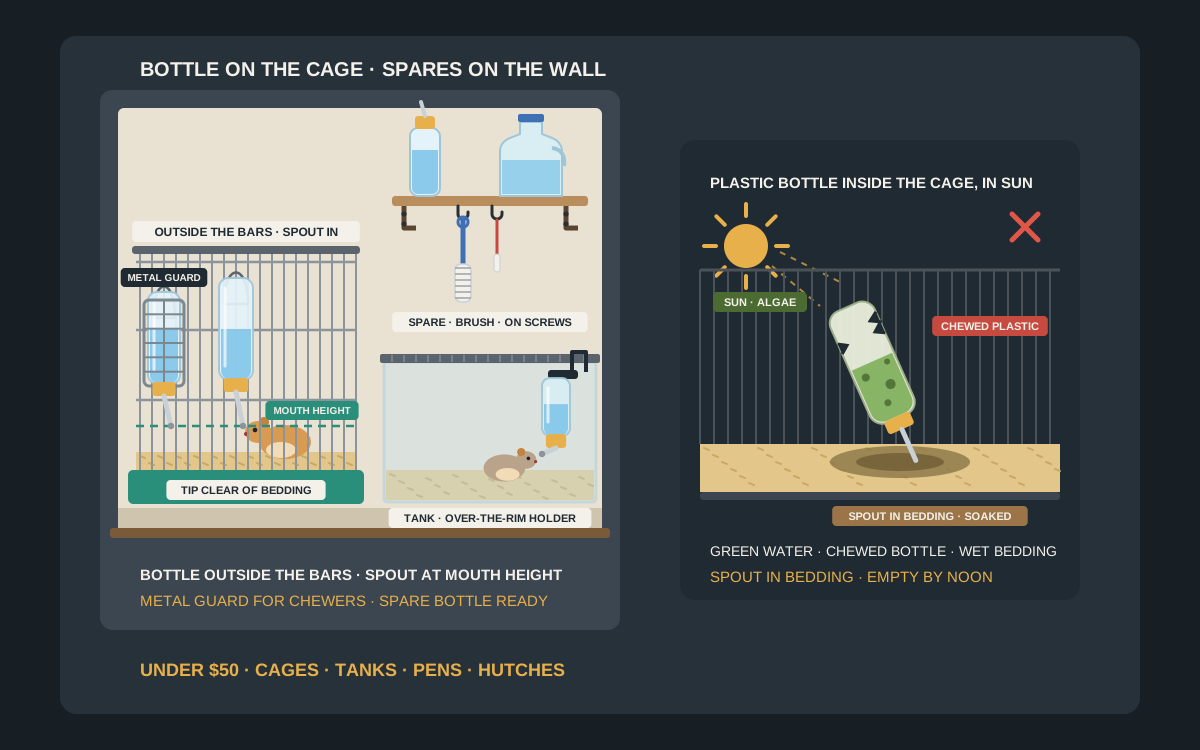
A water bottle is the one piece of small animal gear that has to work every hour of every day, and the holder decides whether it does. Hang it badly and the bottle slides down the bars, the spout ends up buried in bedding and drains the bottle by lunchtime, or a rabbit or guinea pig turns the plastic into a chew toy. This guide compares the holders that fix those problems for under $50, from the wire hanger that came in the box to chew guards, glass-tank holders, pen brackets and a small refill station on the wall beside the enclosure, and shows how to set the height, angle and cleaning routine so your pet always has fresh water.
Shop small animal water bottle holders on Amazon
Who this is for
- Hamster, gerbil, rat, guinea pig, chinchilla and rabbit owners whose bottle keeps slipping down the bars, dripping into the bedding or getting chewed
- Owners of glass tanks, bin cages, C&C cages and exercise pens, where there are no horizontal bars for a standard wire hanger to grip
- Anyone who wants a tidy refill station on the wall next to the enclosure, with a spare bottle, a bottle brush and the cleaning kit in one place
Quick answer
For a bar cage, the best under-$50 setup is the bottle’s own wire hanger, or a sturdier clip-on holder, mounted outside the cage so only the metal spout pokes through the bars, with the tip at your pet’s mouth height and clear of the bedding. For chewers such as rabbits, guinea pigs, chinchillas and rats, put the bottle in a metal guard or switch to a glass bottle. Glass tanks and bin cages need an over-the-rim, suction-cup or stand-style holder instead. Then add a small shelf or hook rail on the wall beside the enclosure for a spare bottle and a bottle brush, so a clean, full bottle goes in while the dirty one soaks. Check the listing’s current size, fit and price before you buy.
Quick comparison
| Format | Best for | Mounting | Trade-off |
|---|---|---|---|
| Wire cage-bar hanger (often included) | Bar cages for hamsters, gerbils, mice and calm rats | Hooks over horizontal bars outside the cage | Free and simple; slips on wide or vertical bars and offers no protection from chewing |
| Metal chew guard or holder | Rabbits, guinea pigs, chinchillas, rats and other chewers | Clips or hooks onto bars; bottle sits inside the metal sleeve | Stops gnawing on the bottle; must match your bottle size |
| Over-the-rim or suction tank holder | Glass tanks and bin cages with no bars | Hooks over the tank edge or sticks to clean glass inside | Works where hangers cannot; check the lid still closes and test suction cups daily |
| Pen or wall bracket | Free-roam rabbits, C&C cages and exercise pens | Screws to a wall or board, or clips to the pen panel | Bottle stays put off the floor; keep a heavy bowl as well for rabbits |
| Wall refill station (shelf + hooks) | Spare bottle, bottle brush, nozzle brush and a water jug | Small shelf and hooks screwed into studs or anchors beside the enclosure | Makes the daily swap fast; water is heavy, so adhesive is out |
Chew-proof bottle guardsGlass tank bottle holdersGlass sipper bottles
What to look for
Fits your enclosure wall
Start with the wall the bottle will hang on, because that decides the holder. Wire hangers grip horizontal bars, so check that the hanger suits your cage’s bar spacing and wire thickness; cages with vertical bars only, wide-spaced bars or a fine mesh often need a clip-on holder or a cable tie at the top. Glass tanks have smooth walls and a lid, so they need a holder that hooks over the rim, a suction-cup bracket or a stand that sits inside. Bin cages can take an over-the-rim holder, or a spout pushed through a drilled hole with the bottle outside. Hutch and pen mesh usually takes a hanger plus a clip. Measure before you buy, because a holder that does not fit the wall is the reason most bottles end up in the bedding.
Holds the spout at the right height and angle
A good holder keeps the bottle upright and the spout pointing down at a fixed height, so it does not drift lower every time your pet pushes it. Look for a firm clamp or a second contact point rather than a single loose loop of wire. The holder should let you set the spout tip at mouth height for the smallest animal that uses it, and keep the tip well clear of the bedding and the food bowl. If a holder only works with the spout touching the floor, it is the wrong holder.
Stands up to teeth
Rabbits, guinea pigs, chinchillas, rats and degus gnaw on anything within reach, and a chewed plastic bottle leaks, empties and can leave plastic in the cage. Mounting the bottle outside the bars, so only the stainless spout is inside, solves most of it. For determined chewers, or where the bottle has to sit inside the enclosure, choose a metal guard that encloses the bottle or a glass bottle with a metal holder. Guards are often sized for particular bottle sizes, so check that your bottle’s diameter and length match the guard, or buy a bottle and guard sold as a set.
Easy to lift off, refill and clean
You will take the bottle down at least once a day, so the holder should release it with one hand without unscrewing anything from the cage. A wide-mouth bottle that takes a bottle brush is far easier to keep clean than a narrow one, and a holder that also takes a second bottle gives your pet a backup if one spout blocks. Plastic holders with tight corners trap grime; simple wire and metal shapes wipe clean.
Cage hanger vs chew guard vs tank holder vs pen bracket vs refill station
When the bottle’s own wire hanger is enough
Most sipper bottles come with a spring-wire hanger that hooks over the horizontal bars and presses the bottle against the outside of the cage. On a sturdy bar cage for a hamster, gerbil, mouse or a pair of calm rats, that is often all you need. It fails when the bars are too far apart, when the cage has vertical bars only, or when your pet climbs the front and knocks the bottle up and down. A cable tie around the bottle neck and the bar above it stops the slide, as long as you trim the tail flush and keep the cut end outside the cage where nobody can chew it.
When a metal chew guard is worth it
If you have ever found tooth marks on the bottle, buy a guard before the bottle starts leaking. Metal guards wrap the bottle in a steel sleeve or cage so only the spout is exposed, and some holders are designed for glass bottles, which chinchilla and rabbit owners often prefer because glass does not invite chewing the way soft plastic does. Mount the guarded bottle outside the bars whenever you can. Check the guard’s listed bottle size against your bottle, or buy a matched set, because a loose bottle rattles inside the guard and a tight one will not go in at all.
When a tank or bin-cage holder is the answer
Glass tanks and bin cages have smooth walls, so the standard hanger has nothing to grip. You have three options. An over-the-rim holder hooks over the tank edge and holds the bottle inside; make sure the lid still closes flat, because hamsters squeeze through surprisingly small gaps. A suction-cup holder sticks to the inside of clean glass and is easy to place, but suction cups can let go when the glass is dirty or the room cools at night, so check it every day for the first week. A freestanding bottle stand sits on the floor of the enclosure and needs no mounting at all, at the cost of floor space and, for wooden stands, eventual soaking and chewing. Bin-cage owners often drill a hole for the spout and hang the bottle outside, which keeps the bottle away from teeth entirely.
When a pen or wall bracket makes sense
Free-roam rabbits, guinea pigs in C&C cages and animals in exercise pens often do best with a bottle holder screwed to a wall, a board or a pen panel at a fixed height. The bottle stays off the floor, out of the litter area and away from kicked-up hay. Many rabbit welfare organizations recommend a heavy ceramic bowl as a rabbit’s main water source, because rabbits tend to drink more from a bowl than a bottle, so for rabbits treat the bracket as a reliable backup rather than the only water.
When a wall refill station earns its spot
A short shelf or hook rail on the room wall next to the enclosure, not on the cage itself, turns the daily water change into a 30-second job. Keep a spare bottle, a bottle brush, a narrow nozzle brush, a cloth and a jug of water there, and the swap becomes: lift off the used bottle, hang the clean full one, and wash the used one later. Put the station out of direct sun, away from heaters and well away from outlets and power strips in case of spills. A full jug is heavy (a US gallon of water weighs about 8.3 lb), so screw the shelf into studs or into anchors rated for the load rather than relying on adhesive.
Height, angle and flow
Set the spout at mouth height
Watch your pet drink. The spout tip should sit about level with its mouth when it is standing or stretching up slightly, so it drinks with its head level or a little raised, without crouching or craning. In a group with different sizes, such as a young and an adult guinea pig, set the bottle for the smallest animal or add a second bottle at a different height. Once it is right, mark the spot with a small piece of tape on the outside of the cage frame, out of reach of teeth, so every refill goes back at the same height.
Keep the tip clear of bedding and food
Bedding that touches the spout wicks water out of the bottle, soaks the substrate and can leave the bottle empty within hours, and wet bedding quickly turns smelly and moldy. Leave a clear gap between the spout and the deepest point of the bedding, and check it again after every bedding top-up. Avoid hanging the bottle directly over the food bowl or hay rack too; guinea pigs in particular often drink with a mouthful of food, which can clog the spout.
Check the flow every day
Tap the ball in the spout with a finger every time you refill. A drop or two should come out. No drop means a stuck ball, scale or an air lock; a steady drip means a loose cap, a worn washer, a crack or bedding touching the tip. A small amount of dripping is common when the room warms up, because the air pocket in the bottle expands and pushes water out, so keep the bottle away from heaters and sunny windows. Note the water level each morning as well: a sudden change in how much your pet drinks is worth a call to your vet.
Two bottles beat one
A second bottle on the same cage is cheap insurance against a blocked spout or a bottle knocked loose overnight, and it gives a shy animal in a pair its own water. Hang the two at slightly different heights or on different sides of the cage, and refill both daily.
Cleaning and seasonal care
Fresh water daily, a proper wash weekly
Empty and refill the bottle every day rather than topping it up, so yesterday’s water does not sit in the bottom. Once a week, or more often for guinea pigs and anything that backwashes food into the spout, scrub the bottle with a bottle brush and the spout with a narrow nozzle brush in hot water with a little mild, unscented dish soap, then rinse until no soap smell is left. A soak in diluted white vinegar loosens hard-water scale in the spout; rinse thoroughly afterward. This is exactly why the spare bottle on the wall matters: a clean one goes in while the other dries.
Keep bottles out of direct sun
Sunlight warms the water and grows algae in clear bottles, and a green tint or slippery film inside means it is time to scrub. Small animals also overheat easily, so the enclosure itself should not sit in a sunny window or next to a radiator. A tinted bottle hides the water level, so stick with clear bottles and keep them shaded.
Winter in outdoor hutches and cold rooms
Water in a bottle freezes faster than in a deep bowl, and the spout usually freezes first, so a bottle can look full while nothing comes out. Insulated bottle covers slow freezing but do not prevent it. In frosty weather, check outdoor bottles at least twice a day, and keep a spare bottle indoors so you can swap a frozen one for a fresh one in seconds.
Replace worn bottles and spouts
Scratched plastic is hard to get clean, worn washers drip, and bent spouts stop the ball from moving freely. Replace the bottle or its spout when cleaning no longer fixes the problem, and check glass bottles for chips around the neck each time you wash them.
Installing the holder so it stays put
Outside the bars, spout in
Whenever the enclosure allows it, hang the bottle outside the cage with only the metal spout reaching in. Your pet cannot chew the bottle or the holder, cannot knock the bottle off from inside, and you can lift it off without opening the door. When the bottle has to go inside, as in most glass tanks, choose a holder in metal or glass rather than soft plastic.
Screws for the wall station, light adhesive only for empty hooks
Anything holding water belongs on screws: a shelf with a full jug or spare bottles needs studs or anchors rated for the load. A small adhesive hook for an empty brush is fine on smooth, clean, cured paint within the maker’s weight rating; 3M, for example, lists an application range of about 50 to 105°F for its Command products and advises waiting about seven days after painting. Splashes and humidity next to an enclosure are hard on adhesive, which is one more reason to keep it to the lightest items.
Protect the floor and the bedding
A washable mat under the refill station catches spills during the daily swap. Inside the cage, some owners set a small ceramic tile or a shallow dish directly under the spout so drips land there instead of soaking the bedding; empty and wipe it at every refill.
Test before you trust it
After installing a new holder, fill the bottle, hang it, tap the spout and watch for ten minutes, then check the level and the bedding under the spout the next morning. A holder that has not slipped, a spout that still delivers a drop on a tap and dry bedding below it mean the setup is ready.
Mistakes to avoid
- Hanging a plastic bottle inside the cage where a rabbit, guinea pig, chinchilla or rat can chew it.
- Letting the spout rest in the bedding, which drains the bottle into the substrate.
- Setting the spout so high that the smallest animal has to strain to drink, or so low that it touches the floor.
- Trusting a suction-cup tank holder without checking it every day at first.
- Leaving a clear bottle in direct sun until the water turns green.
- Topping up instead of emptying and refilling, so old water and slime stay in the bottle.
- Relying on a single bottle in an outdoor hutch during frost.
- Putting a full water jug on an adhesive shelf, or the refill station above a power strip.
Related guides
Browse the hub: Pet gear wall mounts under $50 - all guides
- Best Hamster Cage Accessory Wall Hooks Under $50
- Best Guinea Pig Cage Accessory Wall Hooks Under $50
- Best Rabbit Hay Feeder Wall Mounts Under $50
- Best Small Animal Bedding Bin Wall Shelves Under $50
- Best Ferret Cage Accessory Wall Hooks Under $50
- Best Bird Cage Accessory Wall Racks Under $50
- Best Pet Water Fountain Wall Shelves Under $50
FAQ
What is the best way to attach a water bottle to a small animal cage?
Hang it outside the bars on its wire hanger or a firmer clip-on holder, with only the metal spout reaching inside, the tip at your pet’s mouth height and clear of the bedding. Check that the holder fits your bar spacing, and use a metal guard or a glass bottle for chewers such as rabbits, guinea pigs, chinchillas and rats.
How do you attach a water bottle to a glass tank or bin cage?
Use an over-the-rim holder that hooks over the tank edge, a suction-cup holder on clean glass, or a freestanding bottle stand inside the enclosure. Make sure the lid still closes without leaving an escape gap, and check suction cups daily at first. In a bin cage, you can also push the spout through a drilled hole and hang the bottle outside.
How high should a hamster or guinea pig water bottle be?
Set the spout tip about level with your pet’s mouth when it is standing or stretching up slightly, so it drinks with its head level or a little raised. Keep the tip clear of the bedding, and in a group set the bottle for the smallest animal or add a second bottle at a different height.
Should rabbits drink from a bottle or a bowl?
Many rabbit welfare organizations recommend a heavy ceramic bowl as the main water source, because rabbits tend to drink more from a bowl. A bottle in a wall or pen bracket makes a good backup, especially if the bowl gets tipped or fouled. Refresh both every day.
Why is my small animal water bottle dripping or not working?
Tap the ball in the spout. A steady drip usually means a loose cap, a worn washer, a crack, bedding touching the tip or a warm room pushing water out. No flow usually means a stuck ball, mineral scale or an air lock. Clean the spout with a nozzle brush, soak it in diluted white vinegar, rinse well and replace the bottle if the problem continues.
Bottom line
Small animal water bottle wall holders under $50 work when the holder matches the enclosure: a wire hanger or clip-on holder outside the bars for cages, a metal guard or glass bottle for chewers, an over-the-rim or suction holder for tanks and bin cages, and a screwed bracket for pens and free-roam rabbits, with a bowl as well for rabbits. Set the spout at mouth height and clear of the bedding, tap it every day, change the water daily and scrub weekly, and keep a spare bottle and brush on a small screwed shelf beside the enclosure. Check the listing’s current size, fit and price before you buy.