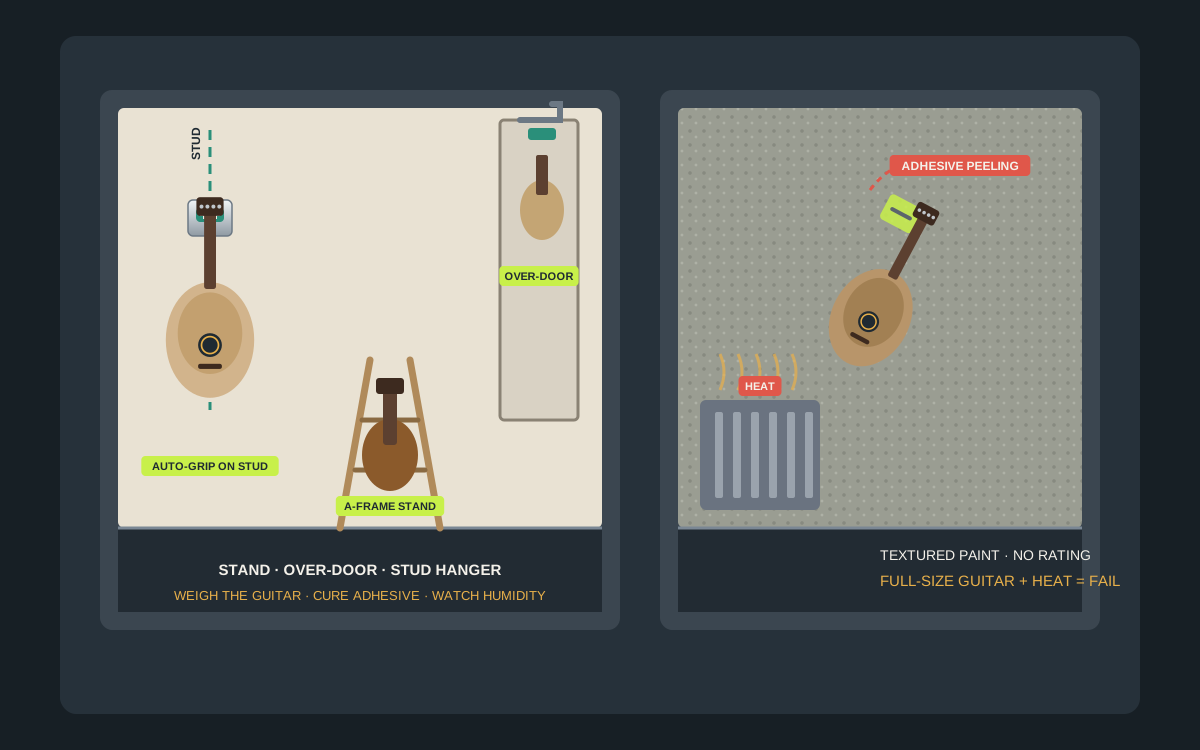
For most apartments, the safest under-$50 no-drill way to store a full-size guitar is a freestanding A-frame or multi-guitar stand, or an over-door hanger on a solid door with soft bumpers, not a decor adhesive hook. Dedicated auto-grip wall hangers are built to hold the instrument by the neck and usually need screws into a stud or solid blocking; treat any adhesive-backed guitar hook as a maybe for a ukulele or other light instrument only, and only when the listing publishes a weight rating that clearly exceeds your guitar with margin. Weigh your own guitar, keep acoustics away from radiators and exterior-wall humidity swings, never hang by the strings alone, and check the listing’s weight rating, fit and current price before you buy.
Shop guitar hangers and stands on Amazon
Who this is for
- Renters who want a guitar off the floor without drilling landlord drywall or risking the deposit
- Players choosing between an auto-grip wall hanger, an over-door hanger, a freestanding stand or an adhesive hook for one acoustic, electric, classical or ukulele under $50
- Anyone who has seen a guitar peel a stick-on hook off textured paint and wants the honest weight and humidity limits before buying
Quick answer
For most apartments, the safest under-$50 no-drill way to store a full-size guitar is a freestanding A-frame or multi-guitar stand, or an over-door hanger on a solid door with soft bumpers, not a decor adhesive hook. Dedicated auto-grip wall hangers are built to hold the instrument by the neck and usually need screws into a stud or solid blocking; treat any adhesive-backed guitar hook as a maybe for a ukulele or other light instrument only, and only when the listing publishes a weight rating that clearly exceeds your guitar with margin. Weigh your own guitar, keep acoustics away from radiators and exterior-wall humidity swings, never hang by the strings alone, and check the listing’s weight rating, fit and current price before you buy.
Quick comparison
| Format | Best for | Mounting | Trade-off |
|---|---|---|---|
| Freestanding A-frame / multi stand | Full-size acoustics and electrics when walls are off-limits | None — sits on the floor | Safest no-drill default; uses floor space |
| Over-door guitar hanger | Renters with a solid bedroom or closet door and clearance | Hooks over the door; soft bumpers | Zero wall damage; check door thickness and swing |
| Auto-grip / yoke wall hanger | Players who can put a screw into a stud or solid blocking | Usually screws; some kits add adhesive pads | Best hang feel; not truly no-drill on drywall alone |
| Adhesive neck hanger (light only) | Ukuleles or other light instruments on smooth sealed walls | Adhesive pads on tile, metal or glossy paint | Only inside a published rating with real margin |
| Floor case or wall-adjacent rack | Valuable instruments, travel weeks, humid summers | Case on the floor or a low rack | Best protection; slower to grab and play |
Auto-grip guitar hangersOver-door guitar hangersFreestanding guitar stands
What to look for
Your guitar’s real weight, not a hopeful guess
A typical full-size acoustic sits around four to five pounds; many solid-body electrics land between six and ten; basses and some baritones go higher; classicals and parlor guitars are often lighter; ukuleles and mandolins are lightest of all. The wall mount has to clear that number with margin, and a hanging guitar is not a static bag on a hook: the neck cradle puts torque and a peel force on whatever is stuck to the wall. Weigh the instrument on a bathroom scale, write the number down, and compare it with the maker’s published rating for your surface. If no rating is published for wall or door use, treat that as a no for hanging.
A mount that matches the instrument and the wall
Auto-grip and yoke hangers cradle the neck just under the headstock so the guitar hangs by the wood, not by the strings. Over-door hangers need a door thick enough for the hook and clearance so the door still closes. Freestanding stands need floor space and a stable footprint. Adhesive pads only belong on smooth sealed surfaces, and even then only inside a published rating that covers your guitar with margin. Textured paint, wallpaper, brick veneer and fresh paint are poor adhesive surfaces for anything this valuable.
Humidity, heat and traffic, not just the hanger
Acoustic tops move with humidity. Hanging an acoustic on an exterior wall next to a radiator, a heater vent or a sunny window invites seasonal cracks and buzz even if the hanger itself holds. Keep the instrument inside the room’s living zone, away from exterior-wall extremes, and use a case or a stand when the apartment runs very dry or very damp. Also keep the hang path clear of doors, coat swings and kids’ reach so a bump does not lever the guitar off the cradle.
Removal and landlord rules you can live with
Screw-in hangers leave holes; some leases allow small holes and some charge for them. Stretch-release adhesive comes off cleaner than foam tape, but neither rescues a guitar that has already fallen. Over-door and freestanding options leave the walls alone. Know which trade-off your lease and your instrument can accept before you peel a liner or open a drill case.
Stand vs over-door vs auto-grip vs adhesive
When a freestanding stand is the right apartment answer
If you cannot or will not put a screw into a stud, a folding A-frame or a small multi-guitar stand under $50 is the honest default. It holds full-size acoustics and electrics without asking the wall for anything, folds when guests come, and fails safe: if it tips, the guitar usually falls a few inches onto carpet rather than peeling off at head height. Look for soft rubber cradles that will not mark the finish, a wide enough base that a cable tug will not topple it, and a height that clears the lower bout. Put it where the door swing and the dog cannot hit it.
When an over-door hanger earns its place
Over-door guitar hangers hang the neck cradle from a hook that sits over the top of a door. They leave the walls untouched and work well on a bedroom or closet door that stays mostly open or that has enough top clearance for the hook. Measure door thickness against the hook depth, add soft foam or felt bumpers so the hanger does not scuff paint, and confirm the door still latches. Hollow-core apartment doors can flex; if the door feels flimsy or the hanger rocks, choose a freestanding stand instead of loading a full-size electric on it.
When an auto-grip wall hanger is worth the screw
Auto-grip hangers clamp the neck when the guitar settles into the yoke and release when you lift. They are the cleanest wall display and the most secure hang for a daily player, but the products sold for guitars are designed around screws into a stud or solid blocking. A drywall anchor alone is a gamble with a swinging instrument. If your lease allows small holes and you can find a stud with a reliable finder, one properly screwed hanger is often safer than any adhesive pad claiming to hold the same guitar. Soft yoke sleeves matter: hard plastic against a nitro or thin finish can leave marks.
When adhesive is honest — and when it is not
Some listings sell guitar or ukulele hangers with adhesive pads and no-drill claims. Treat them as light-instrument tools. A ukulele or mandolin on a smooth sealed surface, inside a published rating with clear margin, after a full cure, can work. A full-size acoustic or electric on textured rental paint is where hangers fail and instruments hit the floor. Decor poster strips and multipurpose hooks that never publish a guitar-specific rating are not a guitar mount. If the listing will not state a weight rating for your surface, do not hang a guitar on it.
When a case or low rack is the smarter call
A valuable instrument, a humid summer, a dry winter with the heat blasting, or a week away from the apartment are all reasons to prefer a hard or well-padded soft case on the floor or a low rack over a wall hang. Wall display is for instruments you grab every day in a stable room climate. Cases win on protection; hangers and stands win on grab-and-play speed.
Weight, fit and what the cradle must clear
Weigh the guitar you will actually hang
Put the instrument on a bathroom scale in its ready-to-hang state — strap buttons, lock strap and capo included if they stay on. That number is what the mount must clear. Do not use a friend’s lighter parlor guitar as a stand-in for your Les Paul-weight electric, and do not assume two light ratings add up if you share a multi-hanger rail.
Neck width, headstock shape and lefty fit
Auto-grip jaws and soft yokes are sized for common neck widths. Very chunky classical necks, some wide acoustics, reverse headstocks and left-handed instruments can sit oddly or fail to trigger the grip. Check the listing’s fit notes and photos for an instrument like yours. A cradle that only contacts the strings or the tuning machines is the wrong cradle.
Clearance for the lower bout and the wall
A hanging guitar needs enough depth from the wall so the lower bout does not scuff paint, and enough side clearance so a door, curtain or coat rail cannot knock it. Hold the guitar against the planned spot and mark the outline with painter’s tape before you commit. Keep strap pegs and cable jacks from acting as levers against the wall.
Treat under-$50 prices as moving targets
Kits, finishes and multipacks move constantly. Verify live weight ratings, dimensions, door-hook depth and price on the listing before you order; this guide uses Amazon search links instead of picking specific products we cannot verify today.
Mounting without wrecking the wall — or the guitar
Prefer no-wall options first in strict rentals
If the lease forbids holes and you are not ready to argue about adhesive residue, start with a freestanding stand or an over-door hanger. Those two solve most apartment guitar-storage problems under $50 without touching paint.
If you do use adhesive, prep like a weight-bearing mount
Smooth sealed surfaces only: glossy painted drywall that has cured for at least a week, metal doors, or similar. Wash, dry, then wipe with isopropyl rubbing alcohol. Apply inside the strip’s temperature range, press firmly for the time the maker specifies, and wait the full cure — often around an hour for stretch-release strips and up to about 72 hours for many foam tapes — before hanging anything. Load a bag of rice or books of similar weight first if you want a rehearsal before the guitar goes up.
If you screw into a stud, do it properly
Find the stud, mark height so the headstock clears and the bout hangs where you can grab the neck comfortably, and use the hardware the hanger maker supplies or calls for. Drywall anchors without a stud are a weak substitute for a swinging instrument. Keep the hanger plumb so the guitar does not twist against the yoke.
Keep heat, steam and sun off the instrument
Do not hang an acoustic above a radiator, beside an always-on heater vent, in a steamy bathroom doorway or in a south-facing window that cooks the top. Finish checks and seasonal humidifiers or case humidifiers matter more for the guitar’s health than the brand of hanger.
Getting adhesive off at move-out
Unload the guitar first. Stretch-release tabs pull slowly straight down along the wall. Foam pads warm with a hair dryer, then saw through with dental floss or fishing line, and roll residue off. Never pry a hanger sideways with the guitar still in it.
Building a small apartment music corner
One grab-and-play spot, one protected spot
Keep the daily guitar on the stand or hanger you trust, and keep the spare or the valuable acoustic in a case during weather swings. A single clear corner beats three scattered hangers that each ask the wall for a little more than it should give.
Cables, headphones and pedals nearby without overloading the mount
Hang headphones and cable loops on their own adhesive hooks or a small shelf — see our headphone and floating-shelf guides linked below — rather than draping weight from the guitar hanger. Extra hanging mass is how marginal mounts fail.
Traffic, pets and tips
Place freestanding stands out of the main walk path. Soft cases on the floor beat a tipped stand with a scratched top. If kids or large dogs share the room, a wall hanger on a real stud can be safer than a light stand, provided the lease allows the screws.
Mistakes to avoid
- Hanging a full-size acoustic or electric on a decor adhesive hook that never publishes a weight rating for your surface.
- Using drywall anchors alone for an auto-grip hanger when the instructions call for a stud.
- Hanging the guitar by the strings or by a strap draped over a nail instead of a proper neck cradle.
- Mounting an acoustic on an exterior wall beside a radiator, heater vent or hot window.
- Loading a freshly stuck adhesive hanger the same hour you put it up.
- Choosing an over-door hanger on a thin hollow-core door that flexes under a heavy electric.
- Draping coiled cables and headphones from the same hanger until the real load is far above the guitar alone.
- Prying an adhesive plate off while the guitar is still in the cradle.
Related guides
Browse the hub: No-drill apartment storage under $50 - all guides
- Best No-Drill Speaker Wall Mounts for Apartments Under $50
- Best Adhesive Headphone Hangers Under $50 for Apartments
- Best Adhesive Floating Shelves for Apartments Under $50 (No Drill)
- Best Command Hooks for Apartment Storage Under $50 (No Drill)
- Best Freestanding Coat Racks for Apartments Under $50
- How to Hang a Mirror Without Nails in an Apartment Under $50
FAQ
What is the best no-drill guitar mount for apartments under $50?
For most renters, a freestanding A-frame or multi-guitar stand, or an over-door hanger on a solid door with soft bumpers. Auto-grip wall hangers are excellent when you can screw into a stud. Adhesive hangers are a maybe for ukuleles and other light instruments only, inside a published rating with margin.
Can adhesive hooks hold a full-size guitar?
Usually that is a bad bet. Full-size acoustics and electrics put real weight and peel force on a wall mount. Unless the listing publishes a weight rating that clearly exceeds your guitar on your surface, and you prep and cure correctly, choose a freestanding stand, an over-door hanger or a stud-mounted auto-grip instead.
How much does a guitar weigh for mounting purposes?
Weigh yours. As a rough guide, many acoustics land around four to five pounds, many electrics between six and ten, basses higher, and ukuleles much lower. The mount must clear your number with margin, including any strap hardware that stays on the instrument.
Will hanging a guitar damage it?
A proper neck cradle is a normal way to store a guitar short-term. Risk rises with hard plastic yokes that mark finishes, hangers that only catch the strings, extreme heat or humidity next to exterior walls and radiators, and falls from failed adhesive. Soft yokes, stable climate and a mount inside its rating keep the risk low.
How do I hang a guitar in a rental without losing the deposit?
Prefer freestanding stands and over-door hangers. If you use adhesive, stick to smooth sealed surfaces, follow cure times and remove with stretch-release or warmed floss rather than prying. If you screw into a stud, confirm the lease allows small holes and keep the hardware modest and patchable.
Bottom line
No-drill guitar storage under $50 works when you respect the instrument’s weight and the wall’s limits: freestanding stands and over-door hangers for strict rentals, stud-mounted auto-grip hangers when a screw is allowed, and adhesive only for light instruments inside a published rating after a full cure. Weigh your guitar, keep acoustics off radiators and exterior-wall extremes, never hang by the strings alone, and verify live ratings, fit and price on the listing before you buy.