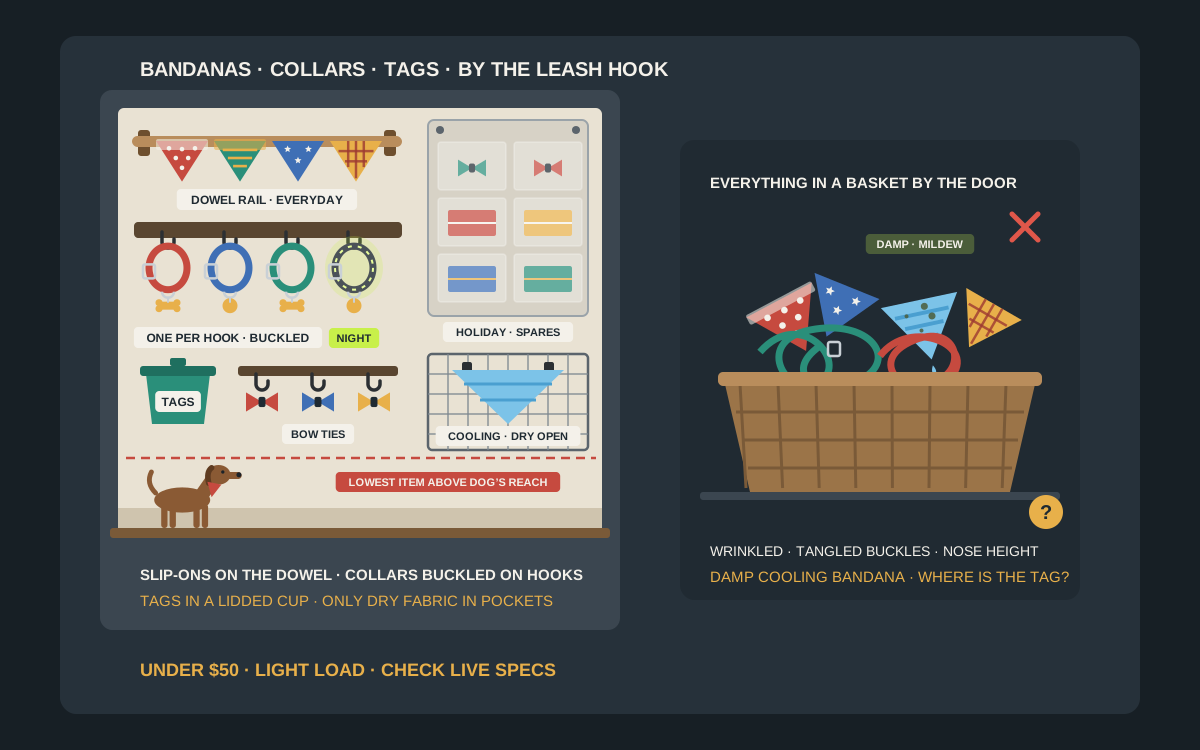
For most homes, the best under-$50 setup is a short dowel or peg rail for the bandanas you use every week, slip-ons threaded on through their collar channel and tie-ons folded over the bar so the print shows and the fabric airs, with a mini hook rail directly below for spare and night collars (one per hook, buckled) and a small lidded cup for tags and charms. Put holiday bandanas, bow ties and folded spares in a clear-pocket organizer above, labeled by dog or season. The load is light, so small screws with anchors, or adhesive strips within their rating on smooth, cured paint, are enough; mount it beside the leash hook, above your dog’s reach and out of the wet entry zone. Check the current dimensions and price on the listing before you buy.
Shop dog accessory wall organizers on Amazon
Who this is for
- Dog owners whose bandana and bow-tie collection (birthday, holiday, team colors, the one from the groomer) lives wrinkled in a drawer or a basket by the door, so the dog wears the same two every week
- Multi-dog homes juggling spare collars, a reflective or light-up night collar, cooling bandanas and ID tags, where each dog’s sizes need to stay separate
- Renters and owners choosing between a dowel or peg rail, a mini hook rack, clear pockets, a wire grid panel or small wall bins under $50, close to the leash hook but away from the muddy entry zone
Quick answer
For most homes, the best under-$50 setup is a short dowel or peg rail for the bandanas you use every week, slip-ons threaded on through their collar channel and tie-ons folded over the bar so the print shows and the fabric airs, with a mini hook rail directly below for spare and night collars (one per hook, buckled) and a small lidded cup for tags and charms. Put holiday bandanas, bow ties and folded spares in a clear-pocket organizer above, labeled by dog or season. The load is light, so small screws with anchors, or adhesive strips within their rating on smooth, cured paint, are enough; mount it beside the leash hook, above your dog’s reach and out of the wet entry zone. Check the current dimensions and price on the listing before you buy.
Quick comparison
| Format | Best for | Mounting | Trade-off |
|---|---|---|---|
| Dowel or peg rail | Everyday slip-on and tie-on bandanas hung in a row | Two screws into studs or anchors; adhesive only for a short, light bar | Prints stay visible and fabric airs; one layer deep, so big collections overflow |
| Mini hook rail (key-rack style) | Spare collars, night collars, bow ties on their straps | Two screws with anchors; adhesive versions for light loads only | One collar per hook, no tangles; tags clink against the wall without a felt pad |
| Clear-pocket organizer | Holiday bandanas, bow ties and folded spares by dog or season | Over-door hooks, or wall screws through the top grommets | Sorted and dust-free; never for damp fabric, and pocket sizes vary |
| Wire grid panel with clips and baskets | Multi-dog homes mixing bandanas, collars, tags and cooling bandanas | Screw-in brackets into studs or anchors | Most flexible layout; clips and baskets add cost and clutter |
| Small wall bin or basket | A stash of plain everyday bandanas, rolled | Screws through the bin back into anchors | Fastest to fill after laundry; items get buried and collars tangle |
Peg & dowel railsClear-pocket organizersWire grid panels
What to look for
Fits your actual accessory mix
Bandanas are not one item. Tie-on triangles fold flat, slip-on (over-the-collar) bandanas have a sewn channel the collar threads through, snap-on and hook-and-loop styles close around the neck on their own, and bow ties usually attach to the collar with an elastic loop or a strap. Add spare collars, a reflective or light-up collar for night walks, a cooling bandana for summer and a handful of charms and tags, and you have fabric, hardware and tiny loose parts competing for one small spot. Count what you actually own, by type and by dog, before you buy anything. A rail suits slip-ons and folded triangles, hooks suit collars, pockets suit bow ties and seasonal spares, and a lidded cup is the only thing that reliably stops tags from vanishing.
Visibility and a one-hand grab
The whole point of putting accessories on the wall is that you can see the collection at a glance and take one piece with the leash already in the other hand. Look for a layout that shows each bandana’s print, keeps collars from tangling and lets you lift one item off without dragging its neighbors along. Clear pockets beat opaque fabric bins, a rail with spacing beats one hook stacked five deep, and an organizer that hides half the collection is how the same two bandanas end up on the dog every week.
Airflow and easy washing
Bandanas collect drool, dirt and dog smell, and cooling bandanas are designed to be soaked. Fabric that goes onto the wall damp will mildew, especially inside a closed vinyl pocket or a bin against a cold exterior wall. Favor open rails and wire grids for anything that might still be drying, keep pockets and bins for clean, dry spares, and choose an organizer you can empty in one move on laundry day and refill in two minutes.
Mounting that suits a light load and a curious dog
Bandanas and collars are light, so this is one of the few pet-gear jobs where good adhesive strips can be the right answer, as long as you stay inside the strip maker’s weight rating and stick them to smooth, clean, cured paint. The bigger risk is the dog. Dangling fabric is a tug toy, and a dog that jumps at the door can grab a bandana and peel a strip off the wall. Mount the bottom row above your dog’s standing reach, and use screws with anchors for anything holding metal collars, a full grid panel or more than a handful of pieces.
Dowel rail vs mini hooks vs clear pockets vs grid panel vs wall bins
When a dowel or peg rail wins
A short wooden dowel on two brackets, a slim towel bar or a Shaker-style peg rail is the simplest bandana display there is. Slip-on bandanas slide onto a dowel through their collar channel and hang like a row of small flags, and tie-on triangles drape over the bar folded in half so the print faces out. A peg rail adds a few pegs below the bar for collars or a short leash. Because the fabric hangs open, a bandana worn on a damp morning dries before you reach for it again. The limits are capacity and fit: a rail shows only one layer, so a big collection needs a second rail or pockets for the overflow, and a dowel that is too thick can stretch the channel on small-dog slip-ons. Slide your smallest dog’s bandana onto the dowel, or measure its channel, before you commit to a diameter.
When a mini hook rail is enough
A key-rack-style rail with four to six small hooks is the right home for collars. Hang each spare collar buckled shut on its own hook, so it keeps its shape and nothing tangles, and give the reflective or light-up night collar the hook closest to the door. Bow ties on an elastic loop or strap hang neatly on the same rail. Most mini hook rails mount with two screws and many include anchors; adhesive versions exist, but metal buckles and D-rings add weight, so check the rating. Tags and D-rings tap the wall every time the door closes, and a couple of felt pads or a strip of cork behind the rail stops both the clink and the paint scuffs.
When clear-pocket organizers make sense
Clear-pocket organizers, the kind sold for shoes, accessories or jewelry, hang over a closet door or on two wall screws and give every folded bandana or bow tie its own window. They are the best home for the holiday and birthday pieces you use a few times a year, for bow ties that get crushed in a drawer, and for spares sorted by dog. A strip of label tape above each column with the dog’s name or the season turns the organizer into an index anyone in the house can use. Pocket sizes vary a lot between listings, so check the inner pocket dimensions against your largest folded bandana, and never put anything damp in a pocket: a sealed vinyl pocket is a mildew chamber.
When a wire grid panel earns the wall space
A wire grid panel, the kind sold for craft rooms and shop displays, takes S-hooks, clips, small baskets and mini shelves anywhere on its grid. In a multi-dog home it can hold one column per dog: bandanas clipped flat at the top, collars on S-hooks in the middle, a cup for tags and a clip where the cooling bandana dries open after a hot walk. It is the most flexible option and easy to rearrange when the collection changes with the seasons. The trade-off is clutter and creep: without a plan it turns into a wall of dangling things, and every basket and clip adds to the total. Sketch the layout before you buy accessories, and screw the brackets into studs or into anchors rated for the load.
When small wall bins are the right call
A small wall-mounted bin or wire basket is the fastest place to drop clean bandanas after laundry, and it suits a large stash of plain everyday bandanas that all look alike. Roll each one so the edges show and you can pick without rummaging, and keep one category per bin. Bins are a poor home for collars, which tangle into a knot of buckles, and for anything you need to see at a glance. Treat a bin as overflow under a rail, not as the whole system.
Organizing bandanas, collars and tags
Hang slip-ons by the channel, fold tie-ons in half
Slip-on bandanas hang best threaded on a dowel or over a hanger bar, because the channel keeps its shape and the bandana is ready to slide straight onto the collar. Tie-on triangles can be folded in half over a rail, or folded into a square and rolled for a pocket or bin. Close snap-on and hook-and-loop styles before they go up, so the hook side does not grab every bandana around it and pill the fabric.
Sort by dog, size and season
In a home with more than one dog, the most common mix-up is the small dog’s bandana stretched over the big dog’s neck. Give each dog its own column, pocket row or color of label tape, and keep sizes together. Then split the collection into everyday, seasonal and special-occasion pieces. Everyday bandanas belong at the front and at easy reach, holiday and costume pieces higher up or in pockets, and pieces nobody uses any more belong in the donation bag, not on the wall.
Collars buckled, one per hook
Spare collars, seasonal collars and night collars keep their shape and stay untangled when each one hangs buckled on its own hook. Hang them by the buckle or D-ring so the strap falls straight, and leave a gap between hooks wide enough that tags do not hook into the next collar. Training tools such as slip leads are better kept at the training or walk station than with the fashion pieces, so the right tool ends up on the dog; the whistle and clicker guide below covers that station.
A lidded cup for tags and charms
ID tags, spare license tags, collar charms and split rings are tiny, and they go missing the moment they sit loose on a shelf. A small lidded cup or a covered pegboard bin, mounted right beside the collars, keeps them together, and a split-ring tool or small pliers can live in the same cup. While you are there, check that the tag on the collar your dog actually wears is current: phone number readable, and the microchip registration updated after a move or a new number.
Care, safety and storage
Wash, then dry fully before storing
Wash bandanas on the cycle and temperature their care label gives, and let them dry completely, flat or on the rail, before they go into pockets or bins. Cotton bandanas can shrink in a hot dryer, which matters most for slip-ons whose channel has to fit over the collar. A quick sniff before folding is a reliable test: anything that smells musty goes back in the wash, not on the wall.
Cooling bandanas need their own drying spot
Evaporative cooling bandanas work by being soaked and then drying on the dog, and some designs have an absorbent insert; others carry a reusable ice pack in a pocket. Either way, hang them open on the rail or a grid clip until fully dry before they move to storage, and follow the maker’s instructions on washing and on whether the insert or pack comes out. Ice packs belong in the freezer, not on the wall. A cooling bandana helps on a warm walk, but it is not a substitute for shade, water and skipping exercise in the heat of the day.
Light-up and reflective collars
Rechargeable light-up collars usually charge over USB, so give them the hook nearest a power outlet, top them up after night walks and unplug them once they are charged. Keep them, and anything else with a battery, away from radiators, heaters and sun-baked exterior walls. Reflective strips stop working well when they are caked with mud, so wipe them before the collar goes back on its hook.
Supervision and fit
Bandanas and collars can snag. Many vets and trainers advise taking bandanas off, along with collars that have dangling tags, before a dog goes into a crate or is left alone, and a bandana should sit about as loose as a well-fitted collar: two fingers slide under it, but a paw cannot get caught. Take a second look at each collar when you lift it off the rail. Frayed stitching, cracked buckles and worn D-rings are easy to spot on the wall, and a worn collar should be retired rather than hung back up.
Installation that holds and stays out of reach
Light loads, but check the wall
A row of bandanas weighs very little, so adhesive strips and hooks are a real option for renters, as long as you stay inside the maker’s weight rating and apply them to smooth, clean, cured paint. 3M, for example, lists an application range of about 50 to 105°F for its Command products and advises waiting about seven days after painting. Textured walls, wallpaper, tile grout and fresh paint are where adhesive lets go. Metal collars, a grid panel or a loaded clear-pocket organizer are better on small screws with drywall anchors, or on a stud if one falls where you need it.
Height above your dog’s reach
Watch how high your dog reaches when it stands up against the wall at the door, then put the lowest item well above that. For a small dog that may be waist height; for a large dog that jumps when the leash comes out, it can mean chest height or higher. A bandana dangling at nose level becomes a tug toy, and swallowed fabric can cause a blockage that needs a vet. If children help dress the dog, one low hook for the everyday bandana, with the rest of the collection higher, works for both.
Near the leash station, out of the mud zone
The most useful spot is beside or just above the leash hook, so the bandana and the collar go on at the same moment as the leash. Keep the fabric away from the strip right inside the door where wet coats, muddy paws and drying towels live. A closet door, a laundry room wall or the hall side of the entry wall usually works better than the spot above the boot tray.
Mock up the layout first
Lay the collection out on the floor in the shape you plan, or tape paper rectangles to the wall, before you drill. Check that clear pockets clear the door trim, that collars hang without touching the rail below, that the tag cup sits where one hand can reach it, and that the lowest item stays above the dog’s reach. Ten minutes of mock-up saves patching holes.
Mistakes to avoid
- Stuffing damp bandanas, especially cooling bandanas, into closed pockets or bins where they mildew.
- Hanging the bottom row at nose level, where the dog can pull bandanas down and chew them.
- Piling five collars on one hook, so buckles, D-rings and tags tangle into a knot.
- Leaving ID tags and charms loose on a shelf until they disappear.
- Mixing different dogs’ sizes, so the small dog’s slip-on ends up stretched on the big dog.
- Putting adhesive strips on textured walls, wallpaper or paint that is less than a week old.
- Storing hook-and-loop bandanas open, so the hook side snags and pills everything around it.
- Keeping fashion bandanas in the wet entry zone next to muddy towels and dripping coats.
Related guides
Browse the hub: Pet gear wall mounts under $50 - all guides
- Best Dog Raincoat & Sweater Wall Hooks Under $50
- Best Dog Harness & Leash Combo Wall Stations Under $50
- Best Dog Leash Wall Hooks Under $50
- Best Dog Whistle & Clicker Wall Organizers Under $50
- Best Dog Coat & Towel Wall Hooks Under $50
- Best Pet Grooming Tool Wall Holders Under $50
- How to Build a Mudroom Pet Station Under $50
FAQ
What is the best way to organize dog bandanas on a wall?
For most homes, a short dowel or peg rail is best for everyday bandanas: thread slip-ons on through the collar channel and drape tie-ons folded in half, so the print shows and the fabric airs. Move holiday pieces and bow ties into a clear-pocket organizer above, labeled by dog or season, and keep the bottom row above your dog’s reach.
Where should I hang spare dog collars?
On a mini hook rail beside the leash station, one collar per hook and buckled shut so it keeps its shape and does not tangle. Put the reflective or light-up night collar on the hook nearest the door or the outlet, and keep tags and charms in a small lidded cup next to the rail.
Can adhesive hooks hold dog bandanas and collars?
Usually, yes, because the load is light. Stay inside the adhesive maker’s weight rating, apply to smooth, clean, cured paint within its temperature range, and avoid textured walls and wallpaper. Use small screws with anchors for metal collars, grid panels and loaded pocket organizers, or anywhere the dog can reach and pull.
How should I store cooling bandanas?
Hang them open on a rail or grid clip until they are completely dry, then fold them into a pocket or bin. Follow the maker’s instructions on washing and inserts, keep reusable ice packs in the freezer rather than on the wall, and never seal a damp cooling bandana in a closed pocket.
Should my dog wear a bandana or collar in the crate?
Many vets and trainers recommend taking bandanas off, along with collars that have dangling tags, before a dog goes into a crate or is left alone, because fabric and tags can snag on the wire. Hang them on the organizer by the door so putting them back on becomes part of the walk routine.
Bottom line
Dog bandana and accessory wall organizers under $50 work when each kind of accessory gets the right home: a dowel or peg rail for everyday bandanas, a mini hook rail for spare and night collars, a lidded cup for tags and charms, and clear pockets for holiday pieces and bow ties, with a wire grid panel if you are organizing for more than one dog. Put only clean, dry fabric into closed storage, keep the bottom row above your dog’s reach, and mount the station beside the leash hook but out of the muddy entry zone. Verify live dimensions, mounting hardware and price on the listing before you buy.