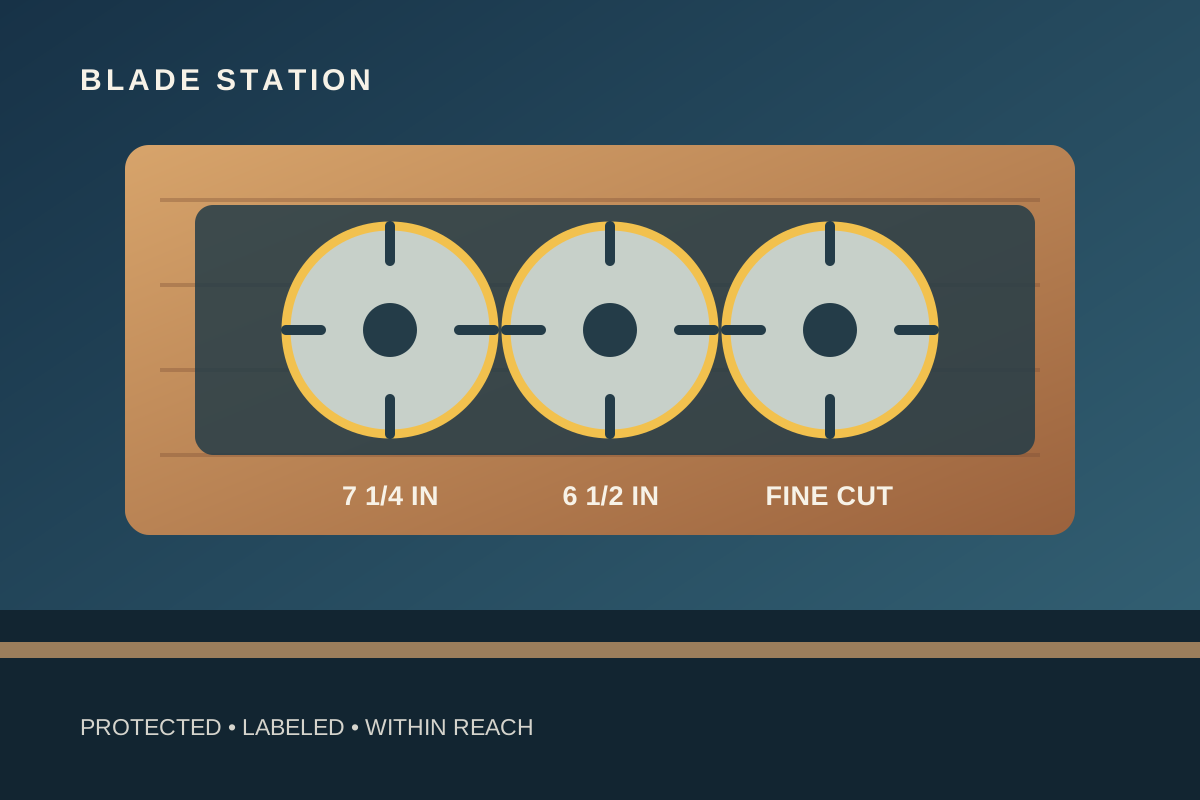
Circular saw blades are expensive to replace and surprisingly easy to damage. A wall-mounted organizer keeps them flat, separated, and visible instead of leaning against a toolbox where carbide teeth can catch or a blade can disappear under offcuts. The best under-$50 setup protects the cutting edge, fits the blade diameters you actually use, and mounts securely without consuming the wall space needed for the saw itself.
Shop circular saw blade organizers under $50 on Amazon
Who this is for
- DIYers who keep 5-1/2-, 6-1/2-, 7-1/4-, or 10-inch blades in the garage
- Woodworkers who want a small blade library beside the saw station
- Small-garage owners who need organized consumables without a deep cabinet
Quick answer
For most garages, choose a shallow rack or case system that stores blades vertically with a protected center opening. A rack is easiest to browse; a lidded case is better when the garage is dusty or the blades travel. Mount it on a stud-backed wall near the saw station, but outside the path of stock, cords, and vehicle doors.
What to look for
Tooth protection and separation
The organizer should keep teeth from rubbing against another blade or a bare screw. Look for individual slots, a covered case, or a smooth divider between diameters. Do not stack loose blades face-to-face and assume the cardboard sleeve is enough.
Diameter and arbor fit
Measure both the blade diameter and the arbor hole before buying. A compact rack may fit 7-1/4-inch blades but leave no safe support for a larger blade; adapters should not be used to make a loose blade sit securely.
Mounting strength and access
Blades are not exceptionally heavy, but a full rack becomes a lever when you pull one out. Prefer screws into studs or a solid backer, and leave enough clearance to lift a blade free without scraping teeth against the wall.
Dust control and labeling
Open racks are quick to scan, while lidded cases protect sharp edges from dust and accidental contact. Either way, label kerf, tooth count, and material so the right blade is a deliberate choice rather than a guess.
Quick comparison
| Organizer style | Best for | Typical price band | Why it wins |
|---|---|---|---|
| Vertical slot wall rack | Everyday garage blade library | Usually $20-$35 | Fast one-at-a-time access with a small footprint |
| Lidded blade storage case | Dusty shops and travel | Usually $25-$45 | Covers teeth and keeps blades grouped by diameter |
| Pegboard blade hooks with sleeves | Existing pegboard walls | Usually under $25 | Flexible layout when each blade has edge protection |
| Shelf with dividers | Mixed blades plus dado accessories | Usually $30-$50 | Room for labels and related cutting consumables |
Shop circular saw blade organizers under $50 on Amazon
How to choose the right style
Open rack or closed case?
Choose an open rack when you change blades often and the wall is clean. Choose a lidded case when airborne dust, children, or travel makes exposed teeth a poor trade-off. A cover is useful only if blades are dry before storage.
Separate blades by job
Keep framing, finish, plywood, and treated-lumber blades in distinct slots or labeled sleeves. Tooth count is not the only distinction: kerf and material rating matter when you are standing at the saw.
Place it beside, not behind, the saw
The organizer belongs within easy reach of the saw station, but never where a long board, cord, or open car door will strike it. Leave a clear lift-out path and enough space to read the label before handling a blade.
How to install and use it
- Inventory the blades you own, recording diameter, arbor size, kerf, tooth count, and whether the blade is for wood, laminate, or another material.
- Choose a wall section outside stock-handling and vehicle-door paths; locate studs or install a rigid backer rated for the organizer and its loaded contents.
- Mount the rack or case level, with the blade opening facing outward and enough clearance to remove one blade without dragging teeth across a bracket.
- Add a label to every slot or sleeve and store each blade dry, clean, and separated from loose hardware.
- After the first week, check that the mount has not shifted and that no blade is rubbing a divider, screw head, or neighboring tooth.
Common mistakes
- Stacking bare blades together so carbide teeth or painted plates rub
- Buying for one blade diameter without measuring the rest of the collection
- Using a single drywall anchor for a rack that is pulled on repeatedly
- Mounting the organizer where lumber, a saw cord, or a vehicle door can hit it
FAQ
What is the safest way to store circular saw blades?
Store each blade in a sleeve, slot, or case that protects its teeth and keeps it dry. A wall rack is safe when it prevents contact between blades and is mounted where people and stock cannot bump the cutting edge.
Can a pegboard hold circular saw blades?
Yes, if the pegboard is securely mounted and each blade has a sleeve or dedicated support. Do not hang a bare blade from a thin hook that lets it swing into another blade or the wall.
Should circular saw blades be stored flat or upright?
Either can work. Upright storage is easier to browse and uses less shelf depth; flat storage is fine when blades are separated and supported. Avoid leaning a heavy stack where lower blades carry all the pressure.
Do I need a separate organizer for 7-1/4-inch blades?
Not always, but a dedicated slot or divider prevents a common blade from being buried under smaller ones. Confirm the rack supports the diameter and arbor before loading it.
Browse the hub: Garage wall storage under $50 — all guides
Related guides
- Best Circular Saw Wall Hangers Under $50 for Garage Storage
- Best Drill Bit Organizers Wall Mount Under $50
- Best Sandpaper Disc Organizers Under $50 (5" & 6" Wall Racks)
Bottom line
The best circular saw blade organizer under $50 protects the teeth, fits your real blade sizes, and stays easy to browse. For a clean garage, a shallow vertical rack is the most convenient choice; for dusty or shared spaces, use a lidded case or individual sleeves. Mount it securely beside the saw station and label every blade so storage improves cutting decisions, not just wall appearance.